
YouTube: How to Start a Successful Youtube Channel and Grow on YouTube
Dylan Reeves-Fellows ⭐️ · YouTuber & Professional Editor
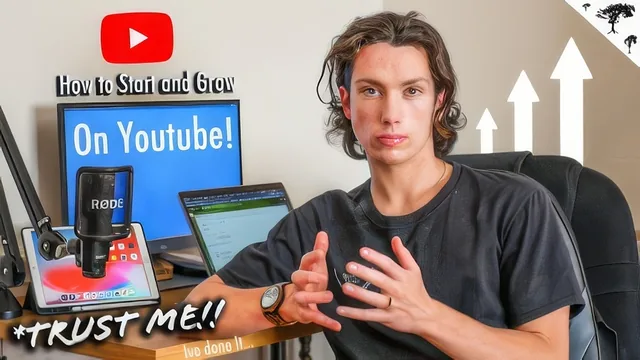
Twenty-three minutes covers gear, camera settings, vlog structure, talking to camera, titles, and metrics, but only at surface depth.
This class positions itself as a start-to-finish primer on becoming a YouTuber, moving from equipment through filming technique to titles and analytics in under half an hour. Coming from a creator who describes building a channel from zero to roughly 41,000 subscribers over four years, the appeal is straightforward: distilled lessons from someone who has actually done the thing. What arrives on screen is thinner than that premise promises.
The gear section is the most concrete part of the course. It walks through a softbox light, a shotgun-style microphone mounted on the camera, a background-blurring lens, and an adjustable tripod, then follows with a companion lesson on camera settings, specifically holding aperture around f/1.7 for a blurred background on sit-down videos while leaving everything on automatic for vlogging. This is legitimate, usable advice for someone who has never touched a camera menu, though it never goes further than naming the settings and explaining why they matter.
The vlog structure lesson is where the class gets more conceptual than practical. It describes a vlog as needing a clear goal stated early, a middle section that wanders through the day collecting footage such as a chat with a friend or a shot of a lake, and a resolution near the end where the goal is achieved or not. It is a reasonable mental model for a first-time vlogger, but it stays at the level of description rather than showing an edited example or breaking down pacing, so it functions more as a checklist than a teachable skill.
The lesson on talking to camera covers looking directly down the lens rather than off to the side, using hand gestures to underline points, and varying vocal inflection as if telling a story to a friend. This is sound performance advice, delivered with an actual demonstration of the flat delivery versus the animated one, which makes it one of the more effective moments in the class.
Where it thins out
The titling lesson draws a genuinely useful line between two approaches: emotionally charged, curiosity-driven titles for vlogs versus precise, keyword-matched titles and descriptions for how-to and review content. That distinction is worth the price of admission on its own, but the class does not go on to show keyword research, competitor analysis, or any tool for finding what people search for.
The metrics lesson name-checks views, subscribers, impressions, and average watch time, and lands on watch time as the metric a beginner should track first. It offers no benchmarks beyond a vague sense that anything under a third of total video length is a warning sign, and no walkthrough of YouTube Studio itself.
The bottom line
The class ends by promising a deeper, more advanced follow-up course and a separate editing tutorial, which underscores its own limitation: this is an overview, not a system. For someone who has never picked up a camera, it compresses the basics into a fast, watchable primer. For anyone past that starting line, there is little here to act on.
The standout
The distinction between titling for emotional curiosity in vlogs versus titling for precise keyword matching in how-to and review videos is the one piece of concrete, transferable advice in the class.
What you will learn
- How to assemble a basic vlogging and sit-down filming setup with a camera, softbox light, shotgun mic, and tripod
- How to set aperture around f/1.7 for a blurred background in sit-down videos versus automatic settings for vlogging
- How to structure a vlog around a single goal, from setup through a journey to a payoff at the end
- How to hold eye contact with the lens and use hand gestures and vocal inflection to stay engaging on camera
- How to write titles and descriptions using emotionally charged words for vlogs and keyword-specific phrasing for how-to content
- How to read average watch time as the primary early-stage metric for judging whether a video is holding an audience
Best for: Absolute beginners who have never uploaded a video and want a fast orientation to the basic vocabulary of gear, filming, and metrics before researching further.
Skip it if: Anyone who already owns a camera and mic, has posted a few videos, or wants specific editing, thumbnail, or algorithm guidance rather than general encouragement.