
You Can Draw Cute People the Easy Way! Learn Drawing for Beginners
Yasmina Creates · Artist & Creativity Cheerleader
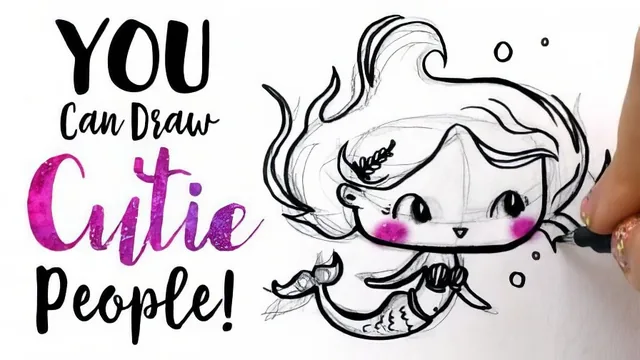
A 23-minute crash course that turns cute-character drawing into one repeatable formula: oval head, bean body, no anatomy homework required.
This class solves one specific problem: beginners freeze up when asked to draw a person because they think they need to understand anatomy first. The instructor's answer is to throw anatomy out entirely and replace it with two shapes, an oval for the head and a curved, kidney-bean outline for the body. Every pose in the class, from a running figure to a ballerina mid-leap, gets built from that same two-shape skeleton, with straight or slightly curved lines standing in for arms and legs. It is a genuinely clever simplification, and the class proves it works by running the same technique across a runner, a texting figure, and a dramatic dance pose without the method ever breaking down.
The middle stretch of the class is where the real teaching happens. A short segment on facial construction introduces a cross-guide inside the head oval, a horizontal line for eye placement and a vertical line for the mouth, which gives beginners a repeatable way to control where a character is looking rather than guessing. Another segment addresses a mistake specific to three-quarter view drawing: forgetting to mark a center line down the body before adding clothing, which throws off symmetry and makes a dress or shirt look subtly wrong. The instructor deliberately shows this error happening in her own example rather than only demonstrating the correct version, which makes the lesson stick better than a polished demo would.
Where the technique earns its keep
The class's core argument, that simplicity is what makes a character read as cute, is backed by concrete visual logic rather than just assertion. A character redrawn with a nose removed, wrinkles dropped, and detail cut by half is shown next to the overcomplicated original, and the difference is obvious. This same instinct carries into the three fully worked examples, a fairy, a mermaid, and a princess, where minor changes like a rectangular head instead of an oval, or longer legs and a neck, visibly shift how old or elegant a character feels. Watching those small variables get adjusted one at a time is more instructive than the earlier rule-listing, because it shows cause and effect rather than stating a principle.
What it does not cover
Because the class runs under 25 minutes, it moves fast and skips anything resembling sustained practice. Hands are addressed in a single aside, mentioned as either simple mitten shapes or a peace-sign gesture, with no dedicated instruction on drawing fingers. Coloring and inking are shown happening but not taught step by step, watercolor washes and a white gel pen appear in the finished examples with no explanation of technique, so anyone hoping to learn paint application will need a separate class, which the instructor herself points to at one point. There is also no structured practice exercise or project brief beyond an open invitation to post in the gallery, so learners have to self-direct their own repetition to actually absorb the method.
As a fast primer for absolute beginners who want a reliable shortcut past the intimidation of figure drawing, the class delivers exactly what it promises. It is not a substitute for a full character design or anatomy course, and anyone who already has basic drawing skills will find the pacing and content too thin to hold their attention.
The standout
The oval-and-bean body construction method, which lets a beginner pose any character convincingly using one repeatable two-shape skeleton instead of learning figure anatomy.
What you will learn
- Building any pose from just an oval (head) and a curved bean shape (body), instead of studying anatomy
- The specific 'cuteness rules': big head-to-body ratio, rounded edges over sharp ones, and stripping detail rather than adding it
- Constructing a face with a simple cross-guide to place eyes on the horizontal line and the mouth on the vertical line
- Drawing hair, clothing, and expressions by pulling loosely from reference images and simplifying what you see
- Adjusting proportions (head shape, neck, leg length) to shift a character's implied age or personality
- Turning outside references (an animal, a video game character, an object) into original character designs
Best for: Total beginners and casual doodlers who want a fast, low-pressure system for drawing appealing characters without formal art training.
Skip it if: Anyone with existing figure-drawing experience or looking for rendering, shading, coloring technique, or anatomically accurate proportions.