
Yes! You Can Draw! Reconnect With Your Creative Self
Amandine Thomas · Award-winning illustrator
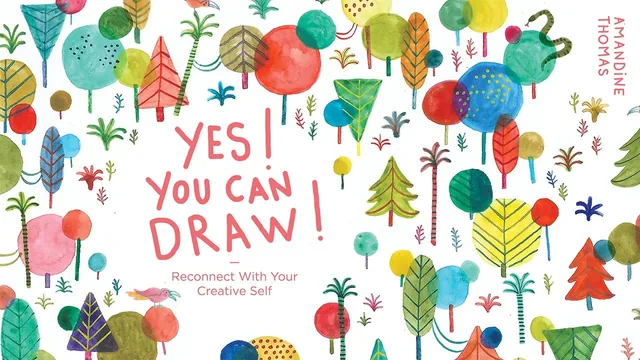
Four quick, oddball drawing exercises trade skill-building for permission to draw badly and enjoy it.
"Yes! You Can Draw!" is not a drawing-skills course, and it says so upfront. Amandine Thomas, a children's book illustrator, spends her 27 minutes on something narrower and more psychological: getting self-conscious former drawers to loosen their grip and stop hiding mistakes. The four core lessons each impose one constraint on a self-portrait, non-dominant hand, unbroken single line, no looking at the page, eyes fully closed, and after each one, Thomas asks students to find something good in the result rather than critique it.
What the exercises actually do
The structure is smart in a small-bore way. Each constraint isolates a specific habit. Drawing with the wrong hand strips away practiced tricks like hatching over a bad line or piling on detail to distract from a weak feature, what Thomas calls "creative crutches." The single-line exercise forces a student to plan where a portrait starts and how the hand will travel from ear to nose before committing pen to paper, which is a genuinely useful rehearsal for spatial thinking. Drawing without looking at the page pushes attention back onto the subject's face instead of the emerging marks, and the eyes-closed round adds a memory component, forcing the student to bank details, a crease between the eyes, the tilt of the mouth, before translating them blind. Each lesson follows the same rhythm: rationale, guideline, demonstration, then a reflection prompt asking what quality the resulting scribble has, not what's wrong with it. That repetition makes the class easy to follow but also fairly predictable by the third lesson.
Where it delivers, and where it doesn't
The reframing exercise is the class's real product. By lesson seven, Thomas walks through how she identified her own strengths, small-scale accuracy, confident line work, speed, and built her illustration career around amplifying them rather than fixing weaknesses. That is a genuinely transferable idea for anyone stuck comparing their sketches to a mental standard of "good." The closing lesson adds three practical habits: carry a sketchbook everywhere, stop obeying rules that don't serve the drawing, and never discard a page immediately since flaws read differently after a few hours.
What the course does not do is teach drawing. There is no instruction on proportion, gesture, perspective, or rendering, and Thomas states this as a design choice rather than an omission. That makes the class honest about its scope, but it also means the title oversells it somewhat: a complete beginner with zero drawing background will finish more relaxed but no more technically capable. The project itself, four constrained self-portraits, works well as a confidence exercise but has a ceiling. Once the novelty of the constraints wears off, there is little here to return to, and the class offers no bridge to what a student should study next beyond a general encouragement to keep sketching.
The value is concentrated and specific: this is a warm-up, a reset, and a way to interrupt bad unconscious habits, best suited to someone who already used to draw and wants back in, not someone learning to draw for the first time.
The standout
The single-line, no-lifting-the-pen portrait exercise in 'Let's Tame Our Lines' does the most to actually change how a student observes and moves before drawing.
What you will learn
- How to spot and interrupt unconscious 'creative crutches' like over-shading or over-detailing
- How to draw a continuous single-line portrait to build spatial awareness
- How to draw without looking at the page to strengthen hand-eye coordination
- How to draw from short-term visual memory with eyes closed
- How to extract personal style cues from self-reflection and peer feedback
- How to reframe 'good drawing' around expressiveness instead of accuracy
Best for: Former drawers who've grown self-conscious and want a fast, low-pressure way back into sketching without technical instruction.
Skip it if: Anyone wanting instruction in proportion, perspective, shading, or any technical skill-building, since the class deliberately avoids all of it.