
Writing Authentic Fiction: How to Build a Believable Character
Sabaa Tahir · Author
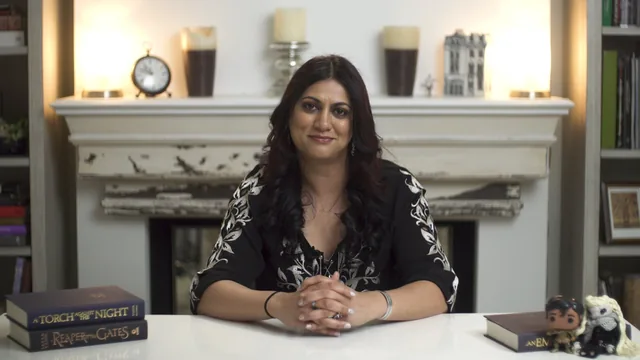
Sabaa Tahir hands over the exact character interview process she used to unstick her second novel, in just 32 minutes.
Sabaa Tahir teaches this class the way she says she wishes someone had taught her before her second novel: not as theory, but as a repair job. She opens by admitting she got partway through writing the sequel to her debut and realized she didn't actually know her characters as well as she thought. The class is her fix for that problem, compressed into three exercises and 32 minutes.
The structure moves in a tight line. First, goal, motivation, and conflict: what the character wants, why, and what's stopping them. Tahir demonstrates with Harry Potter (survive the first year at Hogwarts, to become a wizard, with Voldemort in the way) before turning to her own character Elias from A Torch Against the Night. Second, key attributes: age, ethnicity, appearance, family, orientation, class, education, each one checked against whether it actually feeds the goal-motivation-conflict triangle rather than sitting there as decoration. Her point that not every attribute needs to matter, but the ones that do should be deliberate, is a useful corrective for writers who either over-detail or under-detail their casts.
The centerpiece is the character interview, and it's a genuinely distinct technique among character-building exercises. Tahir has you write out interview questions across five categories (childhood, daily life, personality, digging deep, discomfort), then record yourself answering them out loud, in character, in first person. She walks through her own recorded interview with Elias in full, including his answers about his mother, his worst memory, and his greatest fear, and it's a strong demonstration of how a strange-feeling exercise can produce specific, usable material. She then shows exactly how one line from that interview, about a memory he wishes he could erase, became a real passage in the published book. Watching the raw interview answer turn into finished prose is the clearest proof of concept the class offers.
Where it delivers and where it thins out
The class is honest about its own limits. It never pretends to cover plotting, worldbuilding, or prose style, and it's better for that focus. What it delivers, it delivers with real specificity: concrete worksheets implied throughout (goal/motivation/conflict, attributes, interview questions), a working example carried through all three exercises, and a teacher willing to show her own unpolished process, including admitting she felt ridicular sitting in her office talking to herself.
The thinness shows up in scope and depth. Thirty-two minutes covers three exercises well but leaves little room for troubleshooting: what to do when the interview answers feel flat, how to adapt the technique for an ensemble cast, or how this approach holds up for a character very different from Tahir's own genre and voice. The class also leans entirely on Elias and Harry Potter as examples, so writers working outside fantasy will need to translate the method themselves.
Note also that the class discusses plot points from A Torch Against the Night, the second book in Tahir's Ember in the Ashes series, so anyone planning to read that book unspoiled should watch this after, not before.
As a focused technique class rather than a comprehensive writing course, it earns its short runtime. Writers stuck on a character who won't come alive on the page will get more out of the interview exercise here than from most generic "how to build a character" advice, because it's a specific, repeatable process demonstrated in full rather than described in the abstract.
The standout
The character interview itself, where you speak answers aloud in your character's voice and record them, turns out to generate usable dialogue and scene material you couldn't reach by outlining alone.
What you will learn
- Defining a character's goal, motivation, and conflict as the foundation for their arc
- Distinguishing plot-driven stories from character-driven ones and where most books sit in between
- Building out key attributes (age, appearance, family, class) and tying each one to the character's goal and conflict
- Running a first-person character interview, in voice, to surface details you didn't know you knew
- Mining an interview transcript for lines and moments that can become actual scenes
- Two starter writing prompts (an unsent letter, a gathering-place scene) for putting a new character into motion
Best for: Fiction writers, especially in fantasy or YA, who have a character concept but keep hitting a wall because the character still feels flat or inconsistent on the page.
Skip it if: Writers looking for plot structure, worldbuilding, or prose-craft instruction, since this class stays narrowly focused on character psychology and doesn't touch those areas.