
Watercolor Secrets: Seven Tips to Level-Up your Art
Anna Sokolova · Berlin-based Artist
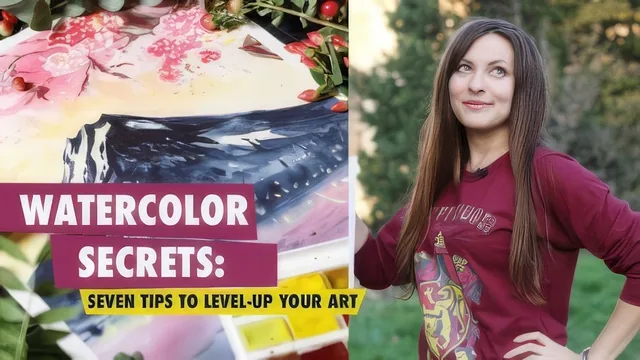
Seven loose watercolor tricks demoed fast and prettily, but light on the explanation beginners actually need.
Seven techniques, one arc
The course opens with a detour: footage shot in Rome, a nod to Michelangelo and the Sistine Chapel, and a compressed history of watercolor running from Lascaux cave pigments through Albrecht Durer to William Turner. It is a pleasant framing device rather than instruction, and at roughly ten minutes into a 101-minute course, it delays the actual content. Once the materials lesson clears away brush and paper choices (a French-style brush, a flat wash brush, a fine synthetic, and paper heavy enough to hold water), the class settles into its real structure: seven short demos, each under ten minutes, each isolating one technique.
The techniques themselves are well chosen and genuinely varied. Dancing Brush is a loose, chaotic warm-up meant to build muscle memory rather than produce a finished image. Fluffy Trees and Clouds both rely on wet-on-wet washes manipulated after the fact, one with a fine brush tip and a hairdryer, the other with paper towels lifting pigment out of a damp sky. Night Glow stands apart: thick paint dropped onto a wet ground creates a surreal, glowing bloom that the teacher then partially lifts to reveal white paper, an effect that looks far more advanced than the two or three minutes it takes to execute. Tape Shape and the Big Project both use cut paper tape as a mask, a craft-adjacent trick that lets a painter drop bold, unrestrained washes around a shape and reveal crisp white afterward. Very Berry Stamp closes the technique set with a stamping method using a pencil eraser or sponge to build clusters of berries quickly.
Where it delivers, and where it falls short
The pacing rewards a painter who already has basic brush control and just wants new tricks to try. Each demo is genuinely quick, and the promise that any technique takes under ten minutes holds up. The final project is a real payoff, stitching together the tape-masking, cloud-lifting, and tree-building techniques from earlier lessons into one cohesive mountain-and-branch composition, which gives the class a satisfying sense of accumulation rather than a pile of disconnected exercises.
Where it weakens is explanation. The teacher talks through her own process in real time, often with phrases like "just paint how you feel it," which suits a viewer who already understands why a wash needs to stay wet or how much water a brush should hold. A true beginner following along may end up mimicking gestures without grasping the underlying control of water-to-paint ratio that makes each technique repeatable. There is also no real troubleshooting: mistakes, timing windows, or common failure points go largely unaddressed, so a first attempt that goes wrong offers little diagnostic help. For a painter who wants a stylistic idea bank to raid, that is a minor cost. For someone hoping to build foundational understanding, it is a real gap the course does not fill.
The standout
The Night Glow demo, where thick cobalt and indigo dropped onto a wet surface and then partially lifted with a dry brush produces a luminous, Van Gogh-like effect without a single stroke of white paint.
What you will learn
- A wet-in-wet brush warm-up for building loose, confident strokes without a set composition
- A layered wash-and-lift method for painting soft indigo evergreen trees using a hairdryer to control timing
- A quick loose-petal technique for flowers and leaves built from strokes that converge toward a center point
- A wet-into-wet glow effect made by dropping thick paint onto a wet ground and lifting highlights, used for night skies
- A paper-towel lifting technique for shaping clouds out of a wet sky wash
- A paper-tape masking method for preserving crisp white silhouettes, demonstrated by cutting the shape of a bird
Best for: Beginners or hobby painters with little formal training who want a fast tour of loose, expressive watercolor effects to imitate and adapt on their own.
Skip it if: Painters who want rigorous technical grounding in color mixing, paper behavior, or paced step-by-step instruction, since the teacher narrates her own process more than she breaks it down for someone starting from zero.