
Watercolor Misty Pines in Monochrome - Step by Step
Trupti Karjinni · Artist, Paintmaker, Entrepreneur
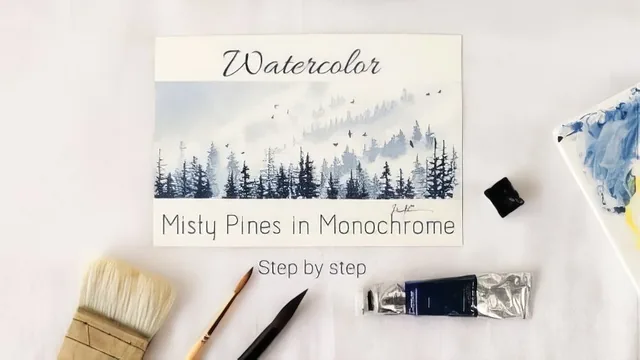
One indigo watercolor, three tonal layers of pine trees, and a single 39-minute sitting produce a finished misty landscape.
A tight, single-pigment landscape project
Trupti Karjinni's "Watercolor Misty Pines in Monochrome" is built around one constraint: paint an entire forest scene using nothing but a single tube of indigo watercolor. That constraint is the organizing idea of the whole class, and it works well as a teaching device. Rather than juggling color theory, mixing ratios, and technique all at once, the course isolates value and water control as the only variables a student has to manage. For a true beginner, that narrowing is a relief rather than a limitation.
The structure is linear and sensible. After a brief supplies rundown covering cold-press cotton paper, a hake brush, a round Kolinsky brush, and a single half-pan of Winsor & Newton Cotman indigo, the course moves into a composition sketch on scrap paper, then a tonal gradient swatch exercise that has students paint the same pigment at several dilutions to see its full value range before committing to the final piece. This swatch becomes a reference the instructor returns to repeatedly during the painting layers, holding it up against wet mixes to check whether a value reads light, mid, or dark enough. It is a small habit, but it is the kind of practical, transferable workflow that separates a course that teaches a technique from one that just walks through a single painting.
The actual pine tree construction is demonstrated in isolation before it is applied to the final paper, which is a smart sequencing choice. Students practice tiny, tip-of-brush strokes that flare wider toward the base of each tree, then immediately follow with a blending pass using a damp brush and a tilted board so gravity pulls the pigment into a soft, misty edge. That same technique is then repeated across four layers of trees, background, mid-layer, foreground, and a final unblended layer, each one a shade darker and slightly more detailed than the last. Watching the layering logic play out four times in a row is where the class earns its keep, since repetition is what actually builds the muscle memory for spacing and value control.
Where it comes up short
At 39 minutes across 13 short lessons, this is closer to a guided project than a comprehensive skills course. Foundational watercolor concepts that a true novice would eventually need, wet-on-wet versus wet-on-dry paper prep, why 300 GSM cold-press paper behaves differently from cheaper stock, or how to recover from a mistake mid-wash, are mentioned only in passing or not addressed at all. The bonus lesson on painting tiny birds and the closing lesson on signing the piece, while pleasant, feel like padding on a class that is already brief.
The pacing also leans heavily on the instructor's own hand movements rather than verbal explanation, so students who need more explicit reasoning behind each brush decision may find themselves rewinding often. That said, for what it promises, a single finished monochrome landscape and a repeatable layering method, it delivers cleanly and without wasted lessons.
The standout
The tonal gradient swatch exercise, which forces a beginner to actually understand the value range of a single pigment before ever touching the final paper, is the one skill that transfers to any monochrome painting afterward.
What you will learn
- Reading a wet paper surface and controlling water-to-pigment ratio so a wash stays wet enough to blend but doesn't pool
- Building a tonal gradient swatch to map out the range of values one pigment can produce before painting
- Constructing pine trees with loose, tip-of-brush strokes that vary density and height for a natural silhouette
- Layering background, mid-ground and foreground trees wet-into-wet to create atmospheric depth and fog
- Tilting the board and using a damp blending brush to soften tree bases into mist
- Adding small V-shaped birds with a fine detail brush as a finishing accent
Best for: Absolute beginners who own basic watercolor supplies and want a fast, guided path to one finished, frameable piece using only one color.
Skip it if: Anyone hoping for grounding in color mixing, multiple pigments, or detailed instruction on paper-wetting and water control beyond a single limited-palette landscape.