
Watercolor Magic: The Basics of Color Mixing and Color Harmony for Modern Painting
Yasmina Creates · Artist & Creativity Cheerleader
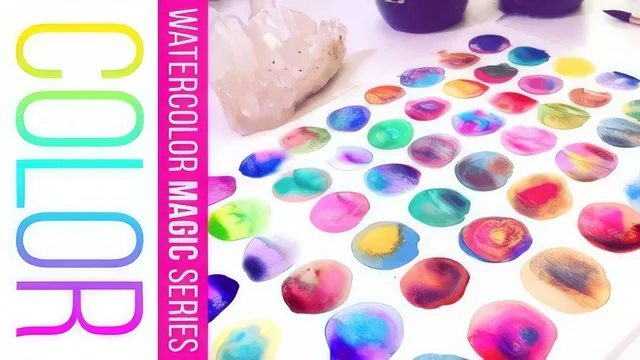
A 24-minute crash course that teaches real watercolor mixing physics but skips almost everything else a beginner painter needs.
What it actually teaches
This class opens with a promise to explain mixing and color harmony in under half an hour, and it mostly delivers on the mixing half. The instructor starts on the palette: load a wet brush with as much pigment as it can carry, park it in a corner of the mixing surface, clean the brush completely before touching a second color, then drag the two toward each other to build a gradient rather than a single flat blend. It is a small technical point, keep pure paint in the corners and mix in the middle, but it is the kind of detail that separates muddy palettes from usable ones.
The color wheel exercise is the strongest stretch of the course. Rather than accepting the schoolroom claim that red, yellow and blue are the primaries, the instructor builds one wheel from those colors and a second from true cyan, magenta and yellow equivalents (turquoise, cyclamen and daffodil yellow in this case), then points out that the CMY wheel produces a genuine red and blue through mixing, which by definition disqualifies red and blue as primaries. It is a legitimate and slightly subversive correction that most beginner classes skip entirely, and it pays off immediately: the wheel becomes the reference for mixing custom blacks, browns and grays by combining complementary pairs instead of buying tube black.
Where the structure thins out
After the palette work, the course moves to painting-surface techniques: wet-on-wet blending, where pigment dropped into a wet shape spreads and mingles, versus a drier brush that holds its position with less bleed. This section is demonstrated well but explained thinly, with a lot of "watch what happens" and comparatively little on why a painter would choose one over the other beyond loose aesthetic preference.
The color theory lesson that follows is competent but compressed. Complementary, split-complementary, analogous, monochromatic, triadic and tetradic schemes each get a sentence or two of definition and one visual example, which is enough to introduce the vocabulary but not enough to build real judgment about when a scheme suits a particular subject. A painter who has never encountered these terms will leave able to name them, not necessarily able to choose between them under pressure.
Exercises and final project
The three practice exercises (a color wheel, an intuitive mixing page, and a mixed palette-and-paper exercise) are genuinely useful low-stakes repetition, and the final project, building a personal swatch library from Pinterest-sourced color inspiration, is a smart, low-effort way to keep the skill alive after the class ends. None of it requires expensive materials beyond the paints already on hand.
At 24 minutes, this is closer to a focused technique demo than a full course, and it reads that way: no discussion of paper types, brush care, or how mixing choices interact with composition. For a painter who already handles a brush and wants a sharper grip on mixing and the vocabulary of harmony, it is efficient and worth the time. For a complete beginner or anyone who has studied color theory before, it will feel thin.
The standout
The side-by-side color wheel comparison, showing a muddy red/yellow/blue wheel next to a vivid cyan/magenta/yellow one, makes the true-primaries argument concrete instead of theoretical.
What you will learn
- How to load and blend paint on a palette without contaminating pure colors
- Why cyan, magenta and yellow (not red/yellow/blue) are the true primaries, demonstrated by building two comparison color wheels
- How to mix a custom black, brown and gray by combining complementary colors instead of using tube black
- The difference between wet-on-wet and dry-brush blending directly on the paper
- The six standard color harmony schemes (complementary, split-complementary, analogous, monochromatic, triadic, tetradic) and when to reach for each
- How to build a personal color-inspiration system using Pinterest boards and Adobe's color wheel tool
Best for: A beginner watercolorist who already owns paint and brushes and wants to stop squeezing straight from the tube.
Skip it if: Anyone who has already taken a color theory class elsewhere, or a total beginner who has never held a paintbrush and needs basic handling covered first.