
Watercolor in the Woods: A Beginner's Guide to Painting the Natural World
Rosalie Haizlett · Nature Illustrator | Top Teacher
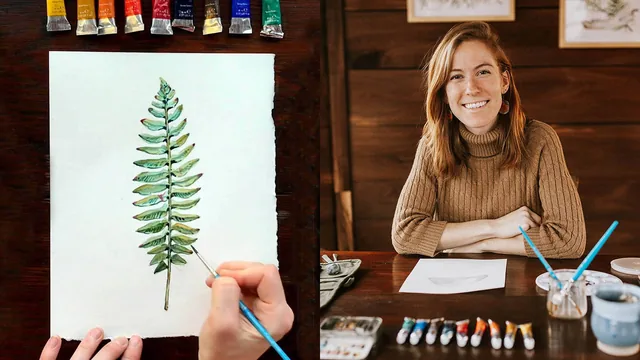
A tight 41-minute walkthrough of dry-on-dry watercolor layering that turns a hike photo into a finished mushroom painting, no prior experience needed.
A short, complete loop from hike to painting
Rosalie Haizlett structures this class as one continuous project rather than a set of disconnected demos. It opens with photographing a subject outdoors, moves through sketching, palette prep, and layered painting, and closes with a bonus fern to repeat the method on a second subject. That arc is the course's biggest strength: a beginner finishes having made two paintings, not just watched one.
The reference-photo lesson is short but genuinely useful, covering focus, front lighting, and shooting multiple angles, the kind of practical advice that gets skipped in most painting classes because it assumes the photo already exists. The "pencil trick," holding a pencil or finger against the reference to gauge proportions before committing to a sketch, is a simple, transferable habit that works for any subject, not just mushrooms and ferns.
The core technique: dry-on-dry layering
The heart of the course is a specific method: dry-on-dry watercolor, painted on dry paper with a barely wet brush, built up in thin layers rather than blended wet-on-wet. Haizlett explains why she prefers it (more control, more detail) and demonstrates it patiently across the mushroom cap and stem, working from a flat gray base coat toward increasingly dark, mixed shadow tones using only her darkest blue and brown rather than black paint. That substitution, dropping black and white from the palette entirely, is a small but concrete lesson in why mixed darks read as more natural than flat ones.
The most practical segment is the error-correction demonstration: flooding a mistake with water and lifting it with a paper towel until it nearly disappears. It is a small moment but it directly answers the anxiety that stops most beginners from loosening up with the medium. The texture section that follows, covering fine detail lines, blotting, and paint-flicking, is compact but gives just enough variety to avoid a painting that looks uniformly smooth.
Where it falls short
The course is honest about being casual rather than technical. Haizlett repeatedly says she does not know the names of her paint colors and is not interested in precise terminology, which suits the relaxed tone but means viewers looking for structured color theory or exact mixing ratios will need to look elsewhere. The background lesson is also thin: she mentions that her first attempt at a leaf-litter background failed and shows the simpler grass alternative she settled on, but does not walk through composing a background from scratch the way she does with the main subject.
At 41 minutes across 13 lessons, this is a compact class, and it earns that length by staying focused on one painting technique applied to two small, forgiving subjects. It will not carry a viewer into complex scenes or multiple-object compositions, but as an introduction to building confidence with a brush, a limited palette, and a single subject, it delivers exactly what it promises.
The standout
The mistake-fixing demonstration, flooding a botched patch with water and lifting it clean with a paper towel, which directly defuses the fear that keeps beginners tentative with watercolor.
What you will learn
- How to scout and shoot a usable outdoor reference photo (subject in focus, front-lit, multiple angles)
- The 'pencil trick' for measuring proportions off a screen or reference before sketching
- How to build a minimal watercolor kit (four brushes, a limited palette with no black or white, a fine-tip pen)
- Dry-on-dry layering to build shadow and contrast gradually instead of overworking wet paper
- How to lift mistakes and muddied highlights with a wet brush and paper towel instead of covering them
- Three texture techniques (fine-line brushwork, blotting, and flicking paint) applied to a bonus fern painting
Best for: A total beginner who already owns or is willing to buy a small watercolor kit and wants one complete, guided painting from photo to finished piece.
Skip it if: Anyone who already knows basic watercolor layering and wants advanced composition, color theory, or multi-subject scene painting.