
Watercolor Autumn Illustrations
Olga Bonitas · Watercolor girl
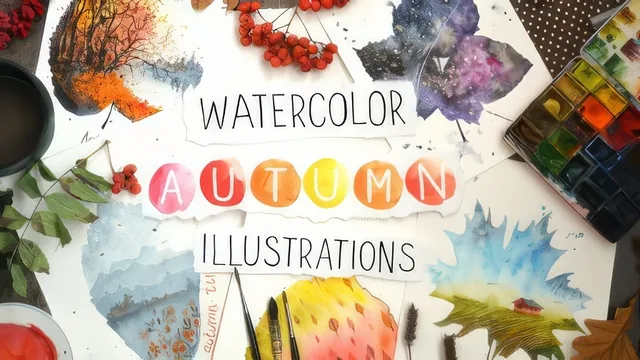
Five quick nature-print watercolor illustrations from real leaves, taught in under an hour with almost no formal color theory.
A Leaf-Shaped Shortcut Into Watercolor
Watercolor Autumn Illustrations solves a specific problem: how to get a beginner from blank paper to a finished, presentable illustration without demanding drawing skill. The trick is structural rather than technical. Instead of teaching someone to draw a leaf, the course has them trace a real one, pressed flat with an iron or weighted under a book for a few days. That outline becomes the canvas for everything that follows, whether it is a starry sky, a mountain range, or a small rural house on a hillside. It is a clever workaround, and it is also the course's whole premise.
The five projects escalate only mildly in difficulty. The first is a straightforward wet-on-wet exercise, wetting the interior of a leaf outline and dropping in yellow, orange, and red so the colors bleed into each other before dark outlines and smaller leaf shapes are added on top once dry. The second introduces a horizon line, a house, and a field of grass, with warmer tones like sienna mixed toward the foreground to suggest depth. The third strips the palette down to just indigo and cadmium orange for a mountain-and-berries composition, a nice demonstration of how much can be done with two colors and value control alone. The fourth, a starry sky painted inside a blackberry leaf, is the clearest technical highlight: white patches are deliberately left dry inside a wet violet-and-indigo wash, and once dry, gouache splashes and a white gel pen turn those gaps into stars. The fifth combines a forest, a shoreline, and a water reflection, layering tree trunks and gradient washes to suggest a mirrored image beneath the treeline.
Where the Teaching Holds Up
The wet-on-wet passages are the strongest part of the instruction. The recurring reminder that changes can only be made while the paper is still wet, and that the work must be left alone once it dries, is a genuinely useful piece of watercolor discipline for a beginner who has not internalized it yet. Small technique notes are scattered throughout: using a thin brush for finer trunk and branch lines, blurring the boundary between a house and the grass around it so there is no hard edge, or fixing an oversaturated area of a wash with a clean, damp brush. These are the kind of practical, hands-on tips that separate a course from a simple demonstration video.
Where It Falls Short
The course does not teach much beyond direct imitation. There is no real color theory, no discussion of brush handling as a distinct skill, and no exercises separate from the five projects themselves. A viewer who has never held a watercolor brush will be able to reproduce the results by following along step by step, but will likely struggle to transfer the technique to an original composition afterward. At under an hour for five projects, several examples move quickly, and viewers wanting elaboration will need to pause and rewatch.
This is best understood as a craft project with a watercolor skin rather than a watercolor course with a craft framing. It rewards anyone who wants a satisfying, low-stakes result fast, especially as a shared activity with a child, but it will underwhelm anyone hoping to leave with a transferable technical foundation.
The standout
The starry-sky leaf demonstration, where wet-on-wet violet and indigo bleed around deliberately left-dry patches to form glowing stars, then gouache and pen add final sparkle.
What you will learn
- How to press collected leaves flat with an iron or a heavy book so they hold shape for tracing
- How to trace a leaf outline and use it as a contour for a wet-on-wet sky, landscape, or starry scene
- Wet-on-wet layering: dropping in yellow, orange, and red while the paper is still wet and letting them bleed together
- Building a two-color minimalist landscape using just indigo and cadmium orange
- Adding gouache and white gel pen highlights for stars, splashes, and fine details after the paint dries
- Painting simple reflections in water using darker, gradient washes below a treeline
Best for: Beginners and hobbyist painters, including parents looking for a low-pressure autumn craft project to do with kids.
Skip it if: Anyone wanting structured color theory, brush control drills, or a technically rigorous watercolor education.