
Visual Journaling: Drawing Your Feelings
Jordan Sondler · Artist and Illustrator
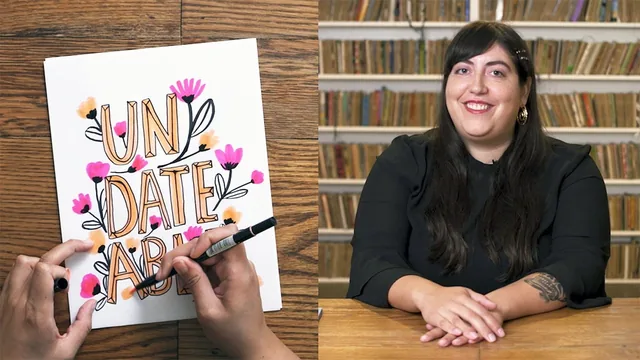
Five quick sketching exercises use art as a feelings-processing tool, not a drawing-skills class, so judge it by that standard.
Jordan Sondler's class is not a drawing tutorial. It is a journaling method that happens to use markers instead of sentences, and it works best when a viewer accepts that framing from the first minute.
Structure and the actual exercises
The 35 minutes split into an intro, a short pep talk on vulnerability, four themed exercises, a freestyle wrap-up, and a closing note. Each themed exercise follows the same rhythm: pick a limited color palette (three or four markers, mostly Tombow dual-tips), work inside a hand-drawn grid of small panels, and fill each panel with one quick idea tied to that day's prompt. The first exercise has no grid at all, it is a single hand-lettered word (Sondler's own example is "undateable") surrounded by loose floral linework. The second and third exercises reuse the same panel template for cataloguing small daily irritations and small daily wants, drawing a rainy window, a near-miss with a car, an overflowing inbox, then a nap, a Philadelphia rowhouse, a glass of wine. The fourth exercise drops the grid again for a single fear-based image. The fifth asks for a freeform piece built from whatever technique felt most natural, demonstrated here as lettering wrapped around a drawing of a cake.
What the method actually teaches
The real content of the course is not "how to draw" but "how to set up constraints so drawing feels possible." The repeated instructions to jot a list beforehand, cap the palette at three or four colors, and box work into small panels are the load-bearing techniques, and they are simple enough to lift and reuse without ever watching the class again. The panel template in particular does real work: turning a blank sheet into eight small confined spaces removes the paralysis of deciding what a whole page should look like, and that idea alone is portable to any future personal journaling habit. The class is explicit that finished pieces do not need to be shown to anyone or even look conventionally attractive, which matters more than it sounds like it should, since it removes the performance pressure that kills most journaling habits within a week.
Where it comes up short
The class is loose about technique in a way that will frustrate anyone hoping to improve their drawing. Line quality, layout choices, and lettering style are demonstrated but never explained step by step, decisions are described as intuitive rather than taught. There is also real repetition: three of the five exercises reuse the identical panel template with only the prompt swapped, so a viewer gets one structural idea stretched across most of the runtime rather than five distinct techniques. The pacing is unhurried to the point of drifting, with asides about markers, neighbors, and inbox count filling time that could have gone to a second technique or a materials rundown. There is no real project outcome either, no single piece to point to at the end, just a loose stack of quick exercises that may or may not amount to anything a person wants to keep.
Who it suits
This is a fast, low-cost way to try a specific journaling method, not a course to take for artistic growth. Someone who already sketches occasionally and wants a structure for using that habit to process a bad day will get real value from the panel-template idea within the first ten minutes. Someone expecting to leave with a stronger illustration technique, a finished portfolio piece, or step-by-step guidance on lettering or composition will find the class thin. The tone throughout is warm and unpretentious, closer to sitting with a friend who journals than a formal lesson, and that tone is arguably the class's biggest asset. It sets expectations honestly rather than overselling what five short exercises can deliver.
The standout
The quadrant template used for the hate and want exercises, which turns an intimidating blank page into small, low-stakes panels worth filling one at a time.
What you will learn
- A repeatable pre-session ritual: jotting inspiration notes, picking a limited color palette, and fixing a paper size before starting
- How to build a simple grid template (quadrant panels) to make blank-page anxiety more manageable
- A four-topic prompt structure (inspiration, hate, want, fear) that can be reused indefinitely for new journaling sessions
- How to combine hand lettering with simple floral or object embellishments around a word or phrase
- A freestyle approach for turning the previous exercises into a repeatable personal series, such as illustrated affirmations
- That a finished piece does not need to be shared or even look good to have done its job
Best for: Anyone who already doodles or journals and wants a structured, low-pressure way to process daily emotions through simple visual prompts.
Skip it if: Anyone looking to learn drawing technique, illustration fundamentals, or a polished finished-art outcome.