Unleash Your Creativity: Draw Without Fear in 5 Simple Exercises
Marie-Noëlle Wurm · Artist, illustrator, HSP
Five short exercises reframe drawing as fearless play, but the whole 40-minute course leans on mindset more than technique.
Marie-Noelle Wurm's class is built on a single reframe: every mark you make is an experiment, not a performance, and an experiment can't fail because it always produces information. That idea, introduced right after the brief intro, is the spine the whole course hangs on. Nothing that follows teaches you how to draw better in a technical sense. Instead, each of the five exercises removes a different psychological obstacle standing between a blank page and a finished mark.
What the exercises actually do
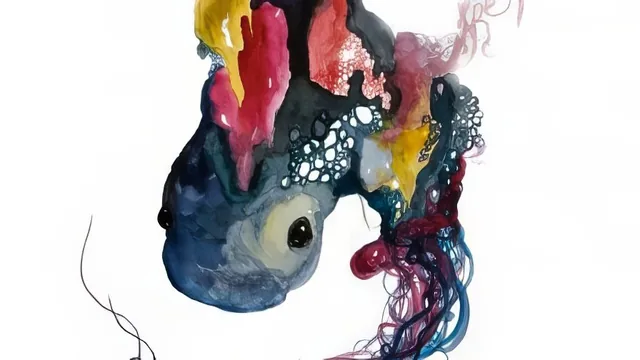
The first exercise is a materials tour disguised as a drawing task: you lay out whatever pens, pencils, watercolors, or charcoal you own and make an abstract page purely to notice which textures you enjoy. The second turns that same page into a hand-lettered title for your sketchbook, a low-pressure way to practice mark-making through letterforms instead of representational drawing. The third is the most substantial, stacking three mini-exercises: a self-portrait drawn with eyes closed, a second done with your non-dominant hand, and a third guided entirely by a piece of music you love, letting tempo and mood dictate line speed and shape. The fourth has you sourcing a reference image (Wurm uses a jellyfish) and pushing it through several rounds of abstraction, useful practice in seeing a subject as shapes rather than a thing you have to copy exactly. The fifth is the emotional centerpiece: draw something carefully, then close your eyes and mark it up on purpose, then work that disruption into a new image. It's a direct, physical rehearsal of recovering from a mistake instead of just being told to "embrace imperfection."
Where it delivers and where it thins out
As a fear-reduction primer, the structure works. Each exercise builds slightly on the last, from playing with tools, to loosening your hand, to sabotaging your own work and rescuing it, and the demos show Wurm's own results and reasoning in enough detail that you're not left guessing what "success" looks like. The music-driven exercise in particular is a genuinely useful prompt that's easy to keep reusing well past the course itself.
What it doesn't offer is any instruction in drawing fundamentals. There's no discussion of proportion, value, perspective, or how to actually improve the accuracy of a line. That's a deliberate choice, not an oversight, since the class is explicitly about psychological blocks rather than craft. But it means the course is a poor fit for anyone who already draws comfortably and wants to get technically better. The pacing is also uneven: several sections repeat the same "this is an experiment, so it can't fail" framing almost verbatim, which starts to feel like padding by the third or fourth repetition. At 40 minutes covering five exercises plus demos, there also isn't much room to linger on any single technique beyond a first try.
This is best understood as a confidence intervention with sketchbook exercises attached, not a drawing-skills course. For someone who avoids drawing entirely out of self-judgment, it's a fast, well-targeted nudge. For someone looking to build actual technical ability, it will feel thin.
The standout
The fifth exercise, making a blind mark on a near-finished drawing and then transforming it into something new, gives a concrete, repeatable way to defuse the fear of ruining a piece.
What you will learn
- How to treat every drawing as a low-stakes 'artistic experiment' rather than a judged outcome
- Blind and non-dominant-hand self-portraits as a way to bypass the inner critic
- Drawing while listening to music so tempo and mood drive line and color choices
- Taking a reference image (the instructor uses a jellyfish) and abstracting it into several stylistic variations
- Deliberately introducing a 'mistake' (an eyes-closed mark) into a finished sketch and reworking it into something new
- Building a personal sketchbook as an ongoing record of discoveries rather than a portfolio of finished pieces
Best for: Total beginners or rusty hobbyists whose main obstacle is fear and self-judgment rather than a lack of technical drawing instruction.
Skip it if: Anyone wanting composition, anatomy, perspective, or color theory instruction, since the class deliberately skips technical skill-building in favor of mindset exercises.