
Understanding the Tarot
Fernando Albert · Your daily dose of Light
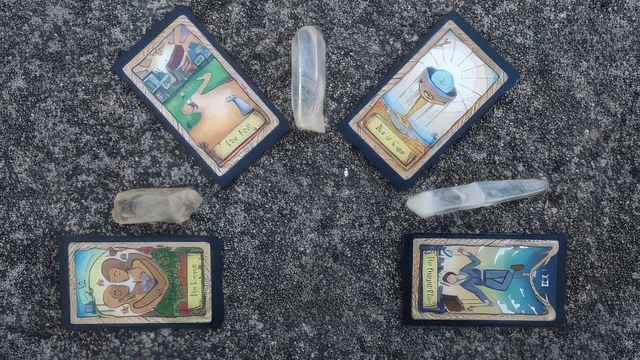
Teaches intuitive tarot reading over rote memorization, but delivers the method across nearly ten meandering, repetitive hours.
A philosophy before a method
"Understanding the Tarot" opens by rejecting the thing most beginners think they need: the little meaning-book that ships inside every deck. The teacher argues, repeatedly and directly, that memorizing fixed card meanings actually gets in the way of reading well. Instead the course front-loads a handful of foundational habits: choosing a deck by the pull of intuition rather than research, spending unhurried time with new cards before ever doing a reading, and treating any spread as optional scaffolding rather than a requirement. The single most useful idea in the whole course arrives early and quietly, a simple test for telling intuition from imagination. Intuition, the argument goes, shows up uninvited as a flash of image, while imagination is something you can feel yourself constructing like a story. Whether or not a viewer accepts the metaphysics around it, this distinction is a genuinely portable tool, the kind of thing that could justify sitting through the rest of the course on its own.
The long walk through the deck
Once the foundations are laid, the bulk of the runtime is spent moving card by card through the deck, starting with the Fool and Magician and continuing well past the Major Arcana listed in the syllabus into an extensive tour of the Minor Arcana suits of cups, pentacles, and swords. Each card gets the same treatment: a description of the imagery, a first gut impression, then two or three narrative scenarios showing how that same card could mean opposite things depending on context, an ace of cups as overflowing abundance in one client's situation and as someone hoarding blessings in another's. It is less a reference guide than a modeled thought process, an attempt to show the viewer how to free-associate off symbolism rather than hand them fixed answers. Woven between the card lessons are bonus additions: guided meditations for activating intuition and relaxing into a reading, and question-and-answer classes covering deck care, cleansing, and what to do when a card jumps out while shuffling.
Where the pacing struggles
The trouble is less what the course covers than how long it takes to say it. Explanations circle back on themselves, the same point about intuition and practice gets restated across nearly every lesson, and the per-card sections lean heavily on personal anecdote that does not always generalize. Several claims are delivered as settled fact rather than personal belief, that a deck carries its own consciousness, that a deck can want to leave for a friend, which will land differently depending on how literally a viewer takes tarot to begin with. The published lesson list also undersells the course's real size, stopping at the Hanged Man when the actual class continues deep into the Minor Arcana and adds dozens more sessions, including a meditation collection that functions more as bonus padding than core instruction. For a course billed as beginner-friendly and straightforward, the runtime asks for real patience, and a tighter edit could likely deliver the same foundation in half the time.
The standout
The lesson separating intuition from imagination, intuition as a sudden unbidden image versus imagination as a story you consciously build, gives a testable rule readers can apply to any deck long after the course ends.
What you will learn
- How to select and bond with a tarot deck by intuitive pull rather than research
- A concrete method for telling genuine intuition apart from imagination during a reading
- Symbolic interpretation of the Major Arcana and a large portion of the Minor Arcana, cups, pentacles, and swords, card by card
- A spread-free reading method: draw one card, absorb it, draw another until the story feels complete
- Pre-reading rituals: clearing the mind and visualizing protective light before shuffling
- Deck etiquette: cleansing, storage, reading for others, and handling more than one deck
Best for: Beginners who already feel emotionally drawn to tarot and want permission to trust instinct over memorizing a guidebook.
Skip it if: Anyone wanting a systematic reference to card meanings, structured spreads, or a tightly paced class will find the anecdote-heavy, repetitive delivery frustrating.