
Understanding and Painting the Head
Marco Bucci · Professional illustrator & teacher
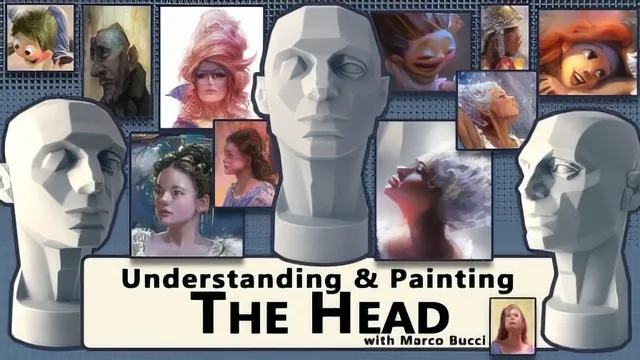
A meticulous, plane-by-plane breakdown of the head that rewards patient study but demands you already know how to draw.
A structural vocabulary, not a step-by-step portrait tutorial
Marco Bucci's "Understanding and Painting the Head" is built around a single governing idea, repeated so often it becomes a mantra: the head is a box, not a sphere. Chapter 1 spends roughly eleven lessons walking through that box one region at a time, brow, cheek, jaw, chin, underside, nose, mouth, ear, eye, before a final assembly lesson stitches the pieces back together. Each segment follows the same rhythm: a quick intro using a simplified reference model called the Asaro head, then a landmark-and-plane breakdown drawn directly over photographs of real models from multiple angles, front, three-quarter, and profile.
The teaching method is consistent and deliberate. Bucci marks landmarks with colored dots, connects them into flat planes, and cross-references a skull diagram to explain why a given ridge or plane change exists anatomically, pointing out subcutaneous bone like the zygomatic arch or the brow's orbital ridge. He is explicit that these are simplified, hard-edged plane divisions meant for understanding first, to be softened later in actual rendering. The proportion lessons are genuinely useful and concrete: the brow line, nose base, and chin form three equal divisions, eyes sit one eye-width apart, and the ear's bottom roughly lines up with the base of the nose. These are the kind of portable measuring tricks that hold up across reference photos rather than gimmicks tied to one face.
Chapter 2 shifts from construction to rendering. Value control gets its own lesson using the Asaro head as a study object, followed by a color-adding demonstration and a comparison of direct versus diffuse lighting. The color study segment introduces an egg exercise: painting a plain ovoid with warm shadow colors against cool light colors to isolate flesh-tone relationships before ever touching a real face, a genuinely transferable habit for anyone learning portrait color. Two watercolor caricature demonstrations close out the practical work, showing how the plane logic from Chapter 1 can be exaggerated for stylized character design, followed by a study-advice lesson on structuring independent practice.
Strengths and limitations
The course's real strength is depth of repetition. Bucci draws the same planes on head after head, different genders, angles, and even a boxer and a cartoon character, so the underlying logic gets reinforced rather than shown once and assumed. His emphasis on rhythm, the idea that flowing curves connect anatomical landmarks across the face, adds a layer beyond dry anatomical labeling, and his running commentary on where the "rules" bend by individual (softer brow ridges on some faces, sharper on others) keeps the material from feeling rigid.
The limitation is pacing and assumed skill. This is not a course that teaches brush handling, digital painting tools, or basic figure drawing; Bucci openly defers software-specific and brushwork topics to other classes. Lessons run long and dense, with minimal recap, so anyone without a working knowledge of perspective and basic shading will struggle to keep up. There is also no single cohesive final portrait project threading the whole course together, the later demonstrations are separate studies rather than a capstone. For an intermediate artist willing to draw alongside every lesson, though, the plane-and-landmark system taught here is durable enough to change how they see a face permanently.
The standout
The egg color study, where flesh tones are worked out purely as warm-shadow versus cool-light relationships on a featureless ovoid before ever touching an actual portrait.
What you will learn
- How to construct the head as a series of flat planes rather than a smooth sphere, treating it fundamentally as a box
- Landmark-based proportion methods (brow-hairline-nose-chin equal spacing, eye-width spacing, tear duct to nose wing alignment)
- How to break down and draw each individual feature (brow, cheek, jaw, nose, mouth, ear, eye) from photo reference in multiple angles
- A value-mapping approach using an Asaro-style head model to assign light and shadow logic to each plane
- A warm-versus-cool color relationship method for flesh tones using an egg-shaped color study
- How to simplify and caricature planes and values into a stylized digital or watercolor portrait
Best for: Intermediate portrait artists and character designers who already draw reasonably well but need a structural, plane-based vocabulary for the head.
Skip it if: Absolute beginners who don't yet have basic drawing or digital painting mechanics, since the pace assumes fluency and offers little hand-holding on tools or technique.