
Thumbnail Sketching: A Magically Simple Technique to Improve Your Art & Drawing Skill
Yasmina Creates · Artist & Creativity Cheerleader
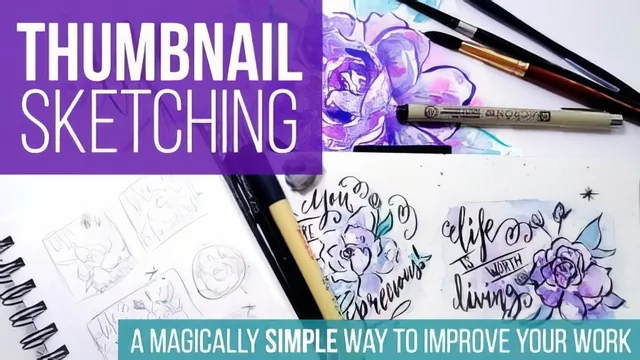
A 12-minute primer that teaches one simple habit, rough small sketches, that measurably improves composition before you commit to a final piece.
A short course built around one habit
"Thumbnail Sketching" does not try to cover much ground, and that restraint is its biggest strength. The entire class rests on a single idea: before committing to a final illustration, logo, or layout, make a handful of tiny, loose sketches to test composition, cropping, and scale. Yasmina Creates spends the first two lessons establishing what a thumbnail is (there are no rules beyond staying small) and showing four different ways to draw one, from a detailed cherry study to a rough doodle boxed into a circle. The point lands quickly: the same idea can be represented many ways in miniature, and seeing several versions side by side makes weak compositions obvious before real time gets sunk into them.
The middle stretch, "Play Around" and "Evolve Ideas," is where the course does its actual teaching. It walks through concrete moves: cropping a cat differently inside vertical versus horizontal layouts, letting an ear or a paw break out of a triangle frame to add visual interest, swapping a rectangle for a circle background. The girl-on-a-swing example is the clearest teaching moment in the class. A single idea gets flipped, recomposed with mountains added, then pushed toward a final version where the girl is isolated in red against a muted background specifically to control where the eye lands. It is a genuinely useful demonstration of how a thumbnail evolves into a resolved composition through small, deliberate changes rather than one perfect first attempt.
Where it thins out
"Brainstorming & References" introduces mind mapping as a way to generate ideas from nothing, using a wolf-to-wildflowers-to-hollow-moon chain as the example. It is a reasonable technique but a familiar one, and the lesson does not go much beyond naming it. The advice to use references as loose guidance rather than something to trace is sound but brief. "Other Uses" gestures at logos, lettering, and website design in under two minutes each, which is enough to plant the idea that thumbnailing generalizes but not enough to actually teach any of those applications in depth. A viewer hoping for guidance specific to UI or web layout will find only a passing mention.
The live example redeems some of that thinness. Watching a rose illustration move from warm-up doodles through two competing layouts, into color tests, and finally to an inked finished piece makes the earlier lessons concrete in a way the isolated examples do not. The closing worksheet lesson, built around a random word generator and a bear-in-bed illustration, is a nice touch that gives the class an actual exercise rather than leaving the technique abstract.
Verdict
This is not a technical drawing course and does not claim to be one. Rendering, anatomy, and rendering skill are never addressed. What it teaches is a planning habit, and it teaches that habit clearly and efficiently in well under fifteen minutes. For an illustrator, letterer, or designer who currently skips straight to a finished piece, this is a fast, low-cost way to pick up a genuinely useful practice. Anyone already thumbnailing as part of their process, or working in digital product design rather than illustration, will find little new here.
The standout
The live example lesson, where the teacher walks a rose illustration from warm-up doodles through two refined layout options to a finished inked and colored piece, showing the whole process compressed into one real project.
What you will learn
- Making small, loose thumbnail sketches to explore layout and composition before starting a final piece
- Experimenting with cropping, scale, and non-rectangular shapes to make a composition more interesting
- Evolving a single idea through a sequence of thumbnails until the composition and focal point feel resolved
- Using mind mapping to generate ideas when starting from a blank page
- Using reference images as loose guidance rather than something to copy directly
- Applying the same thumbnail process to logos, lettering layouts, and a full illustration from rough sketch to finished art
Best for: Illustrators, letterers, and graphic designers who jump straight to a finished piece and want a low-friction habit for planning composition first.
Skip it if: Anyone working primarily in UI or digital product design, since every example here is hand-drawn illustration, lettering, or logo work.