
The Practice of Visual Storytelling: Interviews with Artists
Debbie Millman · Writer, educator, artist, brand consultant
Four tight artist interviews on visual storytelling, but at 46 minutes it is more a highlight reel than a class.
Four conversations, not a curriculum
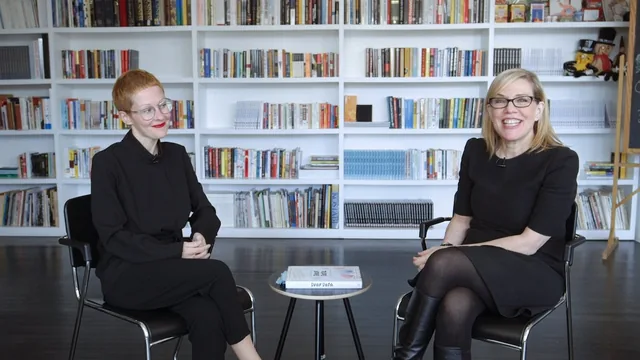
This class is not really a class in the conventional Skillshare sense. It is a curated set of four short sit-down interviews Debbie Millman conducted alongside her exhibition "Text Me" at the Museum of Design in Atlanta, bookended by a brief introduction and closing. There is no project brief, no assignment, and no demonstration of technique. What exists instead is professional conversation: Millman asking practicing artists and designers to articulate how they think, and each of them answering in the specific, sometimes elliptical way people talk about work they have lived inside for years.
The four subjects are genuinely well chosen and cover different corners of the same idea. Adam J. Kurtz talks through the mechanics of his handwritten font, down to the detail that he snaps the tips off his pencils and never lets two handwritten letters look identical, because uniformity kills the illusion of something handmade. Pam Butler, an early street artist, discusses how simplicity and repetition create narrative even without an explicit story, and pushes back on the idea that permission is a prerequisite for making work. Giorgia Lupi walks through how she turned a MoMA fashion exhibit's 111 catalogued items into a hand-drawn data visualization, starting from research questions rather than existing charts. Paul Sahre discusses the discipline of cutting material from his own graphic memoir when it stopped serving the book's central idea.
What it actually teaches
Because each interview runs under ten minutes, none of these ideas gets developed much past the anecdote that introduces it. Lupi's segment is the most substantive, since her explanation of moving from a fixed dataset to a subjective set of interpretive questions is a genuine, repeatable method rather than just a philosophy. The other three interviews lean more toward mindset than method: be honest, do not wait for permission, edit hard, let your hand show through. These are worthwhile reminders for anyone already making work, but they are not exercises a student can practice.
Millman's framing segments, the introduction and the short reflection after each interview, try to convert the conversation into something actionable by posing questions back to the viewer, asking them to consider their own visual voice or what they might be holding back. This helps, but it cannot fully substitute for a structured lesson.
Where it lands
The class works best as a companion piece to Millman's other Skillshare course, "The Art of the Story," which apparently covers the history and hands-on practice of visual storytelling in more depth. On its own, this one functions closer to a curated documentary short than a skills-building course. Production quality is solid and the pacing keeps each segment tight, but 46 minutes spread across four subjects means every idea is introduced and dropped before it can be practiced.
Designers or artists with some experience will get the most out of it, since the value is in hearing how other working professionals talk about intention, editing, and voice, not in acquiring new technique. Anyone hoping for a step-by-step approach to building their own visual story should look elsewhere, or treat this as inspiration to accompany a more structured resource.
The standout
Giorgia Lupi's walkthrough of turning a curator's spreadsheet into categorized questions before any sketching begins is the one transferable method worth stealing.
What you will learn
- How to identify a personal visual voice through handwriting, tone, or recurring motifs, as Adam J. Kurtz describes building his own handwritten font
- Why repetition and juxtaposition of images alone can imply narrative, per Pam Butler's approach to street posters
- A framework for turning research questions into hand-drawn data visualizations, following Giorgia Lupi's spreadsheet-to-sketch process
- How to combine text and image so the design carries the story, illustrated by Paul Sahre's editing choices in his memoir
- The value of ruthless self-editing, both in written narrative and in visual composition
- How to evaluate your own work for honesty and specificity rather than generic polish
Best for: Designers and artists who already have a body of work and want quick, high-level perspective from working professionals rather than step-by-step instruction.
Skip it if: Beginners looking for a structured, skill-building curriculum or any kind of hands-on project to complete.