
T-Shirt Design Workshop 01: Foundation
Ray Dombroski
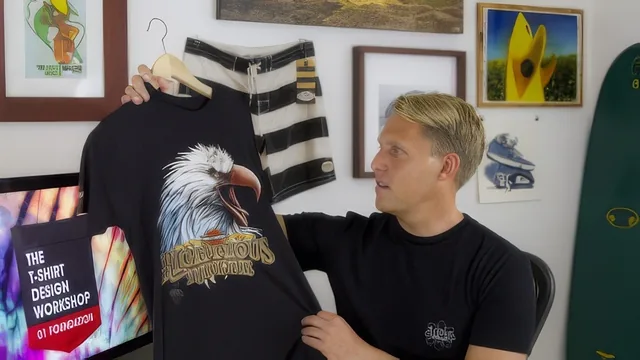
A no-graphics-tutorial primer on t-shirt design's real ingredients: fabric, dye, ink, and printing, taught by a working surf-industry designer.
What it actually covers
This workshop is explicitly a knowledge course, not a skills course. Ray Dombroski, a surf-apparel graphic designer, spends its 72 minutes walking through the vocabulary and physical realities of t-shirt production rather than opening Photoshop. The arc moves from inspiration and history (a tour from Navy undershirts through Marlon Brando, the "I Love New York" napkin sketch, and Nirvana's smiley face) into a long middle stretch on materials and manufacturing, and closes with a demonstration of screen printing a shirt at home. Anyone expecting software tutorials will be disappointed, and the course says so upfront, but that clarity is a strength: it knows what it is.
The middle section is where the real value sits. Dombroski distinguishes cotton, poly-cotton, and tri-blend fabrics by how each takes ink, then separates garment dye from piece dye, and walks through pigment dye, dip dye, and tie dye as distinct effects with distinct looks. From there he covers printing methods: direct to garment, dye sublimation (and its polyester-content requirement and crease-mark quirks), and oversize or cut-and-sew construction, where fabric panels are printed before being sewn into a shirt rather than after.
Color separation is the strongest material
The lesson on color separations is the course's clearest technical payoff. Spot color, CMYK process, simulated process, and index separation are each explained with a visual logic: why changing one CMYK screen color shifts the entire image because of overlapping halftones, versus why an index separation lets you recolor one element without disturbing the rest. This is the kind of practical distinction that actually changes how a beginner looks at a printed shirt, and it is presented with enough specificity to be useful rather than just descriptive.
The specialty inks lesson (puff, high-density, glow-in-the-dark, solar-reactive, flocking, crackle) functions similarly, cataloging effects a new designer would otherwise only learn by trial and error with a printer.
Where it falls short
The screen printing demonstration in the closing lessons is the one place the course gestures at hands-on skill and then pulls back. It shows coating a screen with emulsion, exposing it, washing it out, and pulling ink with a squeegee, but it moves quickly and assumes a home craft kit rather than teaching printing as a repeatable process. Viewers hoping to walk away able to screen print their own shirt will need outside resources to fill the gaps.
The opening story-driven lesson, where Dombroski narrates his own portfolio, is engaging but has limited transferable instruction. It works better as inspiration and proof of expertise than as teaching, and it runs long relative to what it delivers.
Overall this is a context course, and a genuinely useful one for that narrow purpose. It will not make anyone a better designer at the software level, but it gives real footing in the physical and technical decisions, fabric, dye, ink, print method, that separate an amateur graphic from a professional t-shirt.
The standout
The breakdown of the four color separation methods (spot, process, simulated process, index) gives a concrete framework for understanding why printed shirts look the way they do, useful well beyond this one course.
What you will learn
- How to read and choose between cotton, poly-cotton, and tri-blend fabrics for printability and feel
- The difference between garment dye, piece dye, pigment dye, dip dye, and tie dye effects
- When to use direct-to-garment, dye sublimation, or screen printing based on budget and shirt color
- How spot color, CMYK process, simulated process, and index color separations actually work
- How to identify specialty inks like puff, discharge, crackle, and solar ink on finished garments
- The basic home screen printing workflow from exposing a screen to curing ink with an iron
Best for: Aspiring apparel designers who need the vocabulary and production context behind t-shirt graphics before they touch design software.
Skip it if: Anyone wanting hands-on Photoshop or Illustrator instruction, or a full step-by-step guide to screen printing at home.