
Spanish for Beginners. The complete Method. Level 1.
Peter Hanley · The non-stop SPEAKING Spanish course
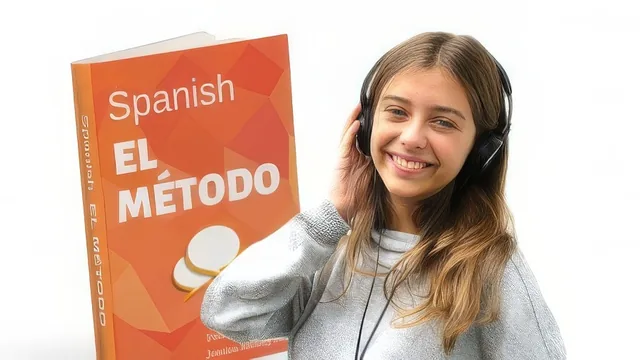
A repetitive drill-and-recall method that gets absolute beginners producing real Spanish sentences fast, but explains almost no grammar.
"El Método" by Peter Hanley is built on a simple premise: beginners learn language the way a child does, by repeated exposure and immediate use, not by reading grammar rules. Level 1 runs 212 minutes across 20 short lessons plus two "Time Trial" review sessions, and it never once shows a conjugation table or a written vocabulary list on screen. Everything happens through spoken call-and-response: Hanley introduces a word, the learner repeats it, then produces their own phrase before hearing the "correct" version from Hanley and his daughter Jessica, who supplies a native accent.
What the course actually teaches
The vocabulary is deliberately narrow and practical: ordering a coffee or a beer, saying where something is, describing whether you are tired or busy, and asking simple questions with cuando, donde, and por que. From there the course builds outward by chaining these blocks together, so a learner who started the lesson only knowing "hola" is producing sentences like "lo siento, pero no puedo hacerlo porque estoy muy cansado" by the end of it. That chaining is the method's real strength. Rather than teaching isolated words, each new item gets folded into everything already learned, so vocabulary accumulates instead of sitting in isolated piles.
Grammar shows up constantly but is never named. The lessons quietly demonstrate that adjectives follow nouns, that object pronouns like "lo" attach to the end of an infinitive verb, and that the ambiguity between ser and estar depends on whether something is permanent or a temporary state or location. A learner who finishes Level 1 will have internalized these patterns through hundreds of repetitions, but anyone who wants to look up why a sentence is built the way it is will find nothing to consult. There is no accompanying written reference, so the entire burden of retention rests on listening and repeating.
Pronunciation coaching and its limits
Hanley spends real time on sounds that trip up English speakers: the single flipped r versus the rolled rr, the soft Spanish c and z compared with the Latin American s pronunciation, the light b/v with no English equivalent, and the fact that Spanish has exactly five pure vowel sounds against English's twenty-odd. This is more pronunciation coaching than most beginner courses attempt, and the side-by-side Spain/Latin America pronunciation notes are a genuinely useful touch for learners unsure which variant to aim for.
The delivery format works against it in places. Because everything is audio-first with timed pauses, the pace depends entirely on how well a learner keeps up in real time, and there's no way to skim back to a specific word without replaying the whole segment. The stated cadence, three passes per lesson, one new lesson a day, a month per level, assumes a level of daily discipline the course itself cannot enforce. It also means a learner who zones out for even one lesson has no easy way to catch up, since each lesson genuinely depends on total recall of the last.
The two Time Trial lessons act as spaced-repetition checkpoints, a smart inclusion missing from most drill-based courses, though they only test recall speed rather than introducing anything new. Overall this is an unusually immersive, listen-and-speak-only method that will suit learners who thrive on repetition and want to talk from lesson one, but it offers nothing for anyone who also wants to read, write, or understand the grammar they are using.
The standout
The drilled pattern of building compound sentences word by word ('quiero saberlo porque es importante') so beginners produce genuinely complex Spanish sentences within the first few hours instead of only memorizing isolated words.
What you will learn
- Core beginner vocabulary and stock phrases for ordering drinks, greeting people, and describing states (busy, tired, sure)
- The verbs querer (want), necesitar (need), tener (have), poder (can), saber (know), hacer (do), salir (leave), comer/cenar (eat/dine), ver (see), and decir (say) conjugated only in first, second, and third person singular
- Spanish vowel and consonant pronunciation (flipped r, soft c and z, light b/v, silent h) taught through repeated spoken imitation
- The distinction between ser and estar introduced practically, through context, without naming the grammar rule directly
- How object pronouns like lo attach to the end of infinitive verbs (verlo, hacerlo, decirlo)
- Basic question formation using rising intonation rather than word-order change
Best for: Absolute beginners who want to speak simple Spanish sentences quickly and learn best by listening and repeating rather than reading grammar tables.
Skip it if: Learners who want written grammar explanations, reading and writing practice, or a course they can follow without dedicating close, repeated listening attention to every lesson.