
Spanish for Beginners. EL MÉTODO. Level 2
Peter Hanley · The non-stop SPEAKING Spanish course
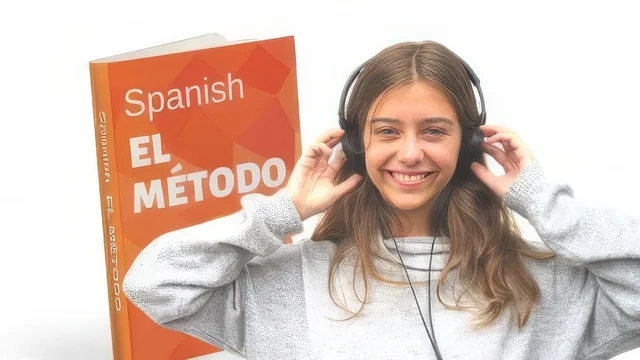
A pure listen-and-repeat drill that pushes past basics into conditional tense and reflexive verbs, but offers zero visual or written support.
A verb-first, ears-only method
This second installment of El Metodo continues its Level 1 format without deviation: a native-accented instructor voices an English prompt, pauses, and the class calls back the Spanish translation before the correct answer is confirmed aloud. There is no camera, no slide, no written word on screen. The entire 223 minutes runs as an audio drill dressed up as video, structured into roughly twenty short lessons punctuated by "Time Trial" review lessons that recycle vocabulary from the two or three lessons prior.
The content itself is genuinely well sequenced. It opens with comprender and the conditional si (if), then builds outward into buying and price negotiation (comprar, caro, cuanto), future plans with voy a, and phone-call vocabulary (llamar, a que hora). By the middle stretch it introduces stem-changing verbs (empezar, pensar, entender) and the formal usted register, explaining clearly that Spanish drops the subject pronoun because the verb ending already carries that information. The final third tackles the conditional mood through me gustaria, reflexive verbs through levantarse, and the tricky gustar construction, where "I like Spain" becomes, structurally, "Spain is pleasing to me." That inversion is walked through patiently and repeated across several sentences, which is the strongest teaching moment in the course.
What actually works, and what doesn't
The drilling itself is legitimately effective for building rapid recall. Sentences compound naturally, starting with single verbs and working up to clauses like "I would like to buy it if it is not too expensive," forcing the learner to chain several lessons' worth of vocabulary in real time rather than practicing isolated flashcards. The numbering and counting exercise near the end, where the instructor has the learner point to numbers on screen while calling them out, is one of the few moments that uses any visual element at all.
The weaknesses are structural rather than incidental. Because there is no text on screen and no written recap, learners get no chance to see spelling, accent placement, or sentence construction, which matters enormously in a language where accents change meaning and verb endings carry grammatical weight. Anyone who wants to read along, take notes, or review a transcript is out of luck. The pacing also assumes the learner already has Level 1 fully internalized, and it moves briskly between grammar points, sometimes introducing a new tense or mood with only a sentence or two of explanation before diving straight back into rapid-fire drilling.
The "Time Trial" lessons, meant to reinforce material, are largely undifferentiated from the regular lessons in format, so they add repetition without adding much new pedagogical value. And because everything hinges on a single audio track with no branching or adaptive difficulty, a learner who struggles with one grammar point has no alternative path forward except to loop the same recording.
This is a course for someone who wants Spanish drilled into muscle memory through repetition and speed, not someone who wants to understand why the grammar works the way it does. It rewards patience and repeated listening far more than a single pass through.
The standout
The recurring gustar-style construction drill, where 'me gusta Espana' is reframed as 'Spain is pleasing to me,' resolves a grammar point that trips up most self-taught learners for months.
What you will learn
- Building near-future tense with 'voy a' plus infinitive for planning and scheduling talk
- Using stem-changing verbs like empezar, pensar, and entender in the present tense
- Forming the conditional with 'me gustaria' to express polite wants and preferences
- Handling reflexive verbs such as levantarse for daily routine actions
- Giving direct commands and imperatives like llamame, hazlo, and ponlo
- Switching between tu and usted register and asking questions with cuando, cuanto, and a que hora
Best for: Auditory learners who already finished Level 1 of this method and want hands-free, repetitive verb drilling during commutes or chores.
Skip it if: Visual learners, anyone who has not completed Level 1, or students who need written text, grammar tables, or corrective feedback on pronunciation.