
Simple Productivity: How to Accomplish More With Less
Greg McKeown · Author & Speaker
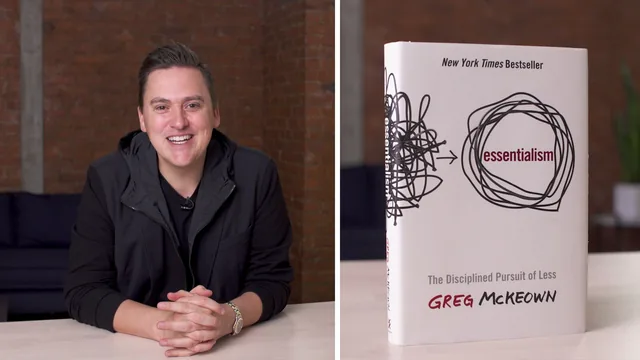
A 44-minute distillation of Greg McKeown's Essentialism into ten short lessons, useful as a mindset reset but light on new mechanics beyond the book.
A book's worth of ideas in under an hour
Greg McKeown built his career on one argument: most to-do lists are not underperforming, they are overstuffed, and the fix is subtraction rather than better time management. This class compresses that argument, first laid out in his book Essentialism, into ten lessons running under 45 minutes. The arc follows the three-part framework he names at the outset: explore what matters, eliminate what does not, and execute the remainder on a routine that requires no willpower. Anyone who has read the book will recognize nearly every story here, including the meeting he attended the day his daughter was born and the Bill Gates "think week" anecdote. That is not necessarily a flaw for a newcomer, but it does mean the class functions more as an audio companion to existing material than as a fresh body of instruction.
The strongest single piece of content is the 90 percent rule: instead of treating every item on a list as roughly equal, rate incoming requests on a 1-100 scale and treat only the 90-and-above cluster as truly essential, since importance follows a power curve rather than a straight line. This reframes the whole class around a checkable habit rather than an abstract call to "focus on what matters." The uncommitting section builds on that logic in a genuinely practical direction. Rather than either completing a commitment out of sunk cost or quietly going silent on it, McKeown offers scripted language for revisiting an agreement honestly, and pairs it with a specific mental trick: ask what you would pay to start this project today, not what you already spent, to strip out the endowment effect that makes people cling to bad investments.
Where the class thins out is execution. The advice to build physical triggers (shoes under the bed, a journal that travels everywhere) and to visualize streaks (Seinfeld's red-X calendar, a child's star chart) is sound but generic, closer to habit-formation content available in dozens of other places than to anything unique to essentialism. The accountability section, which recommends writing a literal signed contract with a stated financial penalty, is a nice concrete tool but gets only a couple of minutes before the class wraps.
Structurally, the ten lessons move logically from diagnosis to elimination to execution to accountability, and the reflective questions McKeown poses along the way (what are you under-investing in, what are you over-investing in) give the viewer something to act on rather than just listen to. But the length works against depth: each idea gets one story and one framing before the class moves on, so nothing gets stress-tested against real complications like a boss who will not accept a slow no, or a client relationship where uncommitting risks the account entirely.
This suits someone who wants the headline version of Essentialism without reading the book, or who wants a short refresher before a quarterly planning session. It offers little to someone who has already absorbed the book's core ideas, since the class does not extend them, and it offers no genuinely new tactical system, mostly a well-told repackaging of one.
The standout
The uncommitting technique, which reframes uninvestment in a bad-fit commitment as an honest renegotiation rather than a flake-out or a stubborn slog to the finish.
What you will learn
- How to apply the '90 percent rule' to filter requests and ideas before saying yes
- How to run a weekly journal-based planning review to reset priorities
- Ways to decline commitments using specific scripts (the slow yes, offering alternative people)
- How to 'uncommit' from an overextended obligation without ghosting the other person
- How to build physical triggers and routines that make essential habits automatic
- How to set up a written accountability contract with a partner
Best for: Professionals and creatives who feel perpetually overcommitted and want a mindset and light system for saying no more deliberately.
Skip it if: Anyone who has already read Essentialism the book, since the class compresses the same stories and frameworks without adding new material.