
Sewing Basics: Make Your Own Clothing
Denise Bayron · Designer & Patternmaker
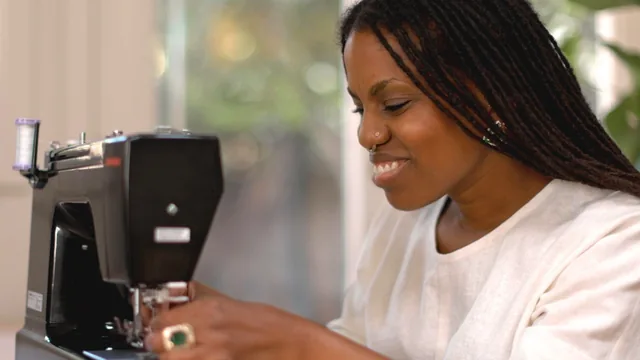
Thirteen lessons of hands-on seam drills teach the exact techniques garment sewing runs on, but you finish without ever having built a garment.
A drill-based approach to garment construction
Denise Bayron's class is built around a deliberate choice: no single garment gets made from start to finish. Instead, every lesson is a practice exercise on scrap fabric squares, aimed at isolating one skill at a time before a learner ever risks a real project. The opening two lessons set expectations and gear (a mechanical Janome, a rotary cutter and mat, glass pins, a seam gauge, painter's tape as a machine-plate guide) before the sewing itself begins with straight-line stitching and 90-degree corner turns, using the needle-down pivot technique and consistent backstitching at the start and end of every seam.
From there the course escalates logically. Concave and convex curved seams get their own lesson, with the clipping and notching techniques explained through the physical reason they work: fabric woven on a grid needs those cuts to stretch or compress around a curve without bunching. This cause-and-effect framing, rather than just "do this," is one of the course's stronger habits.
Seam finishes are the real curriculum
The middle third of the class is essentially a seam-finishing survey: standard seams (shown three ways), a clean finish that folds and top-stitches the raw edge under, French seams sewn wrong-sides-together at a quarter inch and re-sewn at three-eighths to fully enclose the edge, and flat felled seams, the reinforced double-stitched finish used on jeans inseams and other high-stress points. Each gets a rationale tied to fabric type or garment stress, not just technique for its own sake, and Bayron pulls in her own finished garments (a linen kaftan, a pieced sash) to show the finish surviving real wear.
Bias binding and facings round out the neckline-finishing content, and the hemming lesson closes with a practical trick: edge-stitching a hem from the underside rather than top-stitching from the front, so no visible line of stitching shows on the right side. The seam-gauge habit taught here, measuring and pinning at a consistent depth rather than eyeballing it, is worth internalizing on its own.
Where the format costs something
The tradeoff of the practice-square structure is real. A student finishes the class with a genuinely useful vocabulary of seams and finishes but no completed garment and no pattern-reading or fitting instruction, both of which any actual sewing project requires immediately afterward. The closing fabric-shopping lesson, filmed at a natural-dye shop, is pleasant and gives a feel for fiber content and price tiers, but it teaches shopping judgment rather than a sewing skill and stretches the runtime without adding technique.
At under two hours across thirteen lessons, the pacing stays tight, and Bayron's habit of narrating her own small mistakes mid-demonstration (a slightly shifted seam, an over-trimmed facing) does more to normalize beginner error than most technique classes bother to. For someone who wants the underlying skills solid before picking a first pattern, this delivers exactly that. For someone hoping to finish with a wearable result, it will feel like only half the job.
The standout
The French seam lesson, where a quarter-inch seam sewn wrong-sides-together is trimmed, pressed, and re-sewn to fully enclose the raw edge without a serger.
What you will learn
- How to sew straight lines and pivot clean 90-degree corners using backstitching and needle-down turns
- How to clip and notch concave and convex curved seams so they lie flat once turned right-side out
- Five seam-finishing methods: standard, clean finish, French seam, and flat felled, each suited to different fabric weights and stress points
- How to apply bias binding around a curved neckline and how to attach and understitch a facing instead
- How to fold, pin, and press an even hem using a seam gauge, then edge-stitch it invisibly from the underside
- How to evaluate fabric weight, weave, and price point when shopping, including budget-friendly substitutes for natural fibers
Best for: A total beginner who owns a machine, wants a structured technical vocabulary before attempting a real pattern, and is comfortable practicing on scrap squares rather than a finished garment.
Skip it if: Anyone who wants to walk away from the class having actually sewn a wearable item, or who already knows basic seam finishes and needs pattern-fitting or garment-construction guidance instead.