
Self Portraits: Telling Your Unique Story
Tabitha Park · Product & Food Photographer
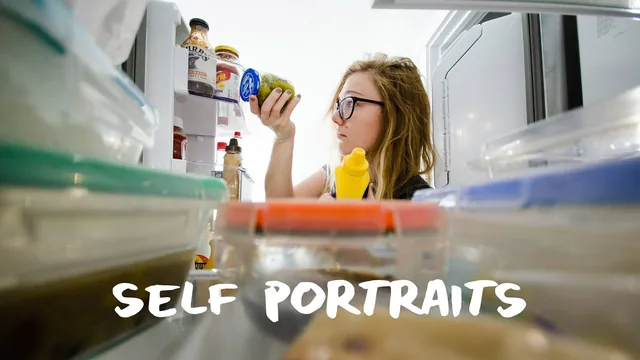
A 32-minute self-exploration exercise on turning autobiography into a single photograph, more journaling prompt than photography lesson.
Self Portraits: Telling Your Unique Story sits closer to a guided journaling exercise than a technical photography class, and it is upfront about that trade. The seven lessons split roughly in half: the first two are about deciding what to photograph, the middle two are about how to physically get the shot alone, and the last two are editing and a slideshow of the instructor's own archive.
The word web exercise is the real spine of the course. Rather than teaching composition rules, it asks the viewer to write their own name in the center of a page and branch outward into pets, habits, routines, objects, and unresolved grief, then look for the branch that already suggests a picture. The instructor's own web, built around a cat, a coffee grinder, a recycling run to a glass dumpster, and a tattoo commemorating a late brother, demonstrates how a mundane routine and a heavy memory can sit on the same list and both be valid subjects. This reframes the "self-portrait" assignment away from a posed headshot and toward a small, specific scene from daily life, which is a useful shift for anyone who freezes up in front of their own camera.
The technical middle
Once a concept is chosen, the course moves into equipment: a lightweight travel tripod, though any sturdy flat surface will do, paired with self-timer mode. The explanation of self-timer settings is the most concrete technical content in the class, covering the three variables that matter (initial delay, number of shots per trigger, and interval between shots) on both a Nikon DSLR menu and an iPhone. The advice to lock manual focus on a stand-in object or person before stepping into the frame is a genuinely practical fix for the single biggest failure mode of solo shooting, blurry or off-focus results from autofocus hunting on an empty spot. An infrared remote gets a brief mention as a way to trigger shots without walking back to the camera each time.
The behind-the-scenes lesson, showing an actual shoot with the instructor's cat while unloading a dishwasher, is short but useful as a demonstration of the shoot-review-reshoot rhythm: fire a burst of nine, walk back, check focus and framing, adjust, repeat.
Editing and the payoff
The Lightroom section is a full but basic pass: exposure and contrast, shadows and blacks, a vibrance and saturation bump, a temperature and tint correction, a light tone curve adjustment, spot removal, and a square crop for Instagram, followed by export settings tuned for a 1,800K file size limit. None of this is advanced color grading, but it is shown start to finish on a real image, and the explanation of picking the one usable frame from 129 shots by star-rating outtakes is a fair look at how much culling a solo shoot actually requires.
The closing slideshow of the instructor's own self-portraits across a decade, including engagement photos, a chore-themed dishwashing shot, and a yearly anniversary photo held next to the previous year's print, works better as inspiration than instruction, but it does make the case that a body of self-portraits accumulates meaning over time.
Where the course falls short is in structured photography fundamentals. There is nothing here on lighting setups, lens choice, framing rules, or posing beyond "stand where you focused." A beginner hoping for a self-portrait technique class in the conventional sense will find only the self-timer and manual focus segments genuinely instructional. What it delivers instead, reliably, is a low-barrier framework for turning an ordinary life detail into one photograph worth taking, which is a narrower but honestly delivered promise.
The standout
The self-timer walkthrough, showing exactly how delay, shot count, and shot interval combine to turn one tripod setup into dozens of usable frames without constant back-and-forth.
What you will learn
- Building a personal word web to mine life events, objects, and habits for visual metaphor
- Setting up tripod or makeshift-surface self-portrait shoots without an assistant
- Programming multi-shot self-timer sequences (delay, shot count, interval) on a DSLR and a phone
- Locking manual focus on a stand-in object or person before stepping into frame
- A full Lightroom pass: exposure, contrast, vibrance, tone curve, spot removal, crop, export settings
- Editing a shoot down by star-rating outtakes to find the one frame where the story actually reads
Best for: Hobbyist photographers who already own a camera or phone and want a structured way to turn a personal story into one intentional image.
Skip it if: Anyone wanting formal portrait lighting, posing, or composition instruction, or a technical deep dive on camera settings beyond self-timer and manual focus.