
Science Fiction & Fantasy: Creating Unique and Powerful Worlds
Lincoln Michel · Fiction Writer and Professor
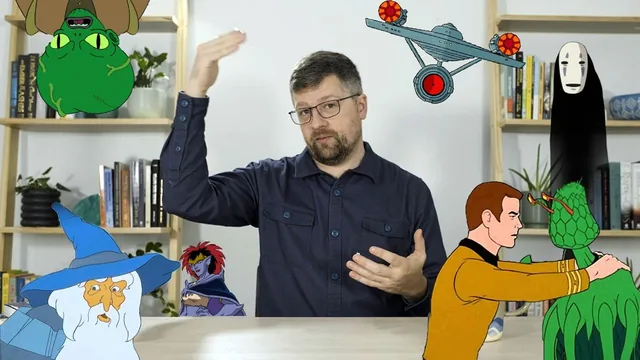
A 62-minute masterclass on thinking through fictional worlds, not on prose craft, that pays off fast if you already have a story stalled.
What it actually teaches
Lincoln Michel's course is not about writing science fiction and fantasy in the sentence-by-sentence sense. It is about the thinking that happens before a single scene gets drafted: how to invent a world, narrow it down to something usable, and find a corner of it nobody else has written. The through-line is the "ripple effect," a habit of taking one impossible premise (dragons, cloning, common werewolves, invisibility potions sold in stores) and tracing its consequences into religion, economics, dating, and class before worrying about plot. Michel uses this to explain why Game of Thrones dragons read as nuclear weapons and why Harry Potter and Lord of the Rings feel distinct despite sharing Western fairy-tale DNA: each author picked a different slice of the ripple effects to dwell on.
From there the course moves through a tight, logical sequence. Focused worldbuilding is the idea that a story is a "vessel" that can only hold so much invention, so a short story needs one ripple effect where a ten-volume epic can hold dozens. Thematic worldbuilding, illustrated through N.K. Jemisin's geology-driven Broken Earth trilogy and a genuinely lovely reading of Italo Calvino's Invisible Cities, is about organizing a setting around one idea rather than an assortment of genre furniture. Granularity gets its own lesson, using two contrasting portraits (a loose Matisse sketch versus a photorealistic Chuck Close painting) to make the point that a fairy-tale register and a Martin-style political register clash badly if mixed within one paragraph.
Where the ideas get concrete
The strongest stretch is the run from "discovering unexplored ground" through "finding new story angles," where Michel stops lecturing in the abstract and works real texts. Lesley Nneka Arimah's "Who Will Greet You at Home?" (children made from yarn or porcelain, depending on class) shows how a single strange premise can carry an entire story about inequality without any economic exposition. Ursula K. Le Guin's "The Wife's Story" flips werewolf horror on its head by narrating from the wolf's point of view, so a man's transformation into human form becomes the frightening image instead of the reverse. These examples do real work, they are specific and well-chosen, and Michel closes the loop by building his own throwaway werewolf-barbershop premise live, step by step, showing how ripple effects, an unexplored niche, and a point-of-view character combine into a workable idea.
The Venn diagram exercise for getting inside a nonhuman character's head, finding five points of overlap between the writer's own frustrations and a goblin wizard's, is a small, genuinely reusable tool, and the SFF-without-worlds detour into Kafka and Aimee Bender is a useful corrective for anyone assuming genre fiction always requires galaxy-scale invention.
The gaps
The course is short enough that not much gets shortchanged, but the trade-off shows. Every exercise stops at the raw-material stage: bullet lists, encyclopedia entries, one-to-three-page free writes. Nothing in the course addresses turning that material into an actual scene, managing exposition, pacing a reveal, or revising a draft, so writers finish with a stack of worldbuilding fragments and no guidance on the next, harder step. The pacing exercises also assume unstructured time (repeated 10-to-20-minute pauses) that suits a workshop setting more than a quick self-paced sitting. As a focused primer on generating original speculative premises, though, it delivers exactly what it promises.
The standout
The ripple-effect exercise, which forces a writer to chase one change (invisibility potions, common werewolves, cloning) through its unglamorous social consequences until a genuinely fresh story angle appears.
What you will learn
- Trace the ripple effects of a single reality-altering premise across society, economy, and belief systems
- Focus worldbuilding around one area of genuine personal interest instead of trying to cover everything
- Use thematic worldbuilding to organize a world around a unifying idea rather than generic fantasy furniture
- Match the granularity and level of detail to the length of the story being told
- Find an unexplored angle on a familiar trope by shifting focus, point of view, or setting
- Use a Venn diagram exercise to find emotional overlap between yourself and a nonhuman or fantastical character
Best for: Beginner to intermediate genre writers who have a premise or setting in mind but keep producing worlds that feel like reheated Tolkien or D&D.
Skip it if: Anyone looking for help with prose style, dialogue, plotting mechanics, or how to actually finish and revise a draft.