
Public Speaking: A Crash Course on Elocution and Confident Speech
Ashley
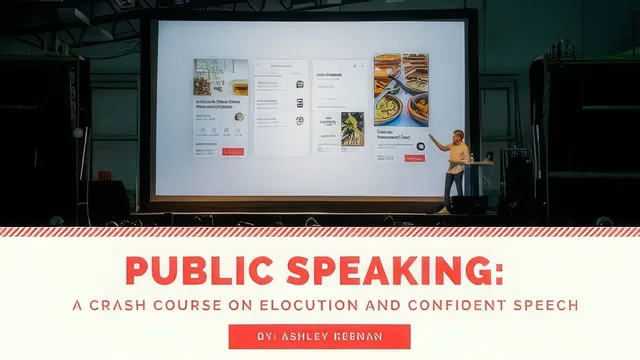
A 25-minute drill session in pitch, breath, and posture that trades depth for speed, best as a warm-up rather than a full toolkit.
What the course actually covers
The course moves through five short lessons: an introduction, then dedicated segments on inflection, projection, clarity and speed, and a closing enunciation drill set. Each middle lesson follows the same pattern: a definition, a short explanation of why the skill matters, a demonstration using a literary excerpt or a well-known speech, and then a read-aloud exercise for the viewer to try on their own. The instructor, Ashley Keenan, draws material from sources like Robert Frost, a Russell Banks short story, Charles de Gaulle's June 18 appeal, and Franklin Roosevelt's first inaugural address, giving the practice sections some literary weight rather than throwaway filler text.
The inflection lesson is the most detailed of the five. It separates pitch from stress from rhythm, explains that rising pitch signals a question while falling pitch signals certainty, and uses the word "right" and the desert/dessert stress pair to show how the same string of letters changes meaning depending on where emphasis falls. The projection lesson pairs a breathing exercise, hand on the stomach, counting inhales and exhales, with a posture drill and a tongue twister about thirty-three thieves. The clarity and speed lesson distinguishes tone from pitch and covers pacing, closing with a short note on gesture illustrated by a clip of Barack Obama.
Where it holds up and where it doesn't
The exercises are the course's real strength. Reading the same text in a monotone voice and then with deliberate pitch variation is a genuinely useful contrast technique, and having learners run through it themselves rather than just watching makes the lesson stick. The closing enunciation lesson, a full alphabet of tongue twisters from "around the rugged rocks" through "zoologists illogically love to read astrology," gives learners a repeatable daily drill they can return to long after finishing the course.
Where the course falls short is depth and polish. At 25 minutes across five lessons, no single topic gets more than a few minutes of instruction before moving to the next, so viewers get a taste of pitch, stress, breathing, and pacing without enough repetition to build real muscle memory. The delivery itself undercuts the subject matter at points: word stumbles and mispronunciations surface periodically, which is a rough fit for a course specifically about clear articulation, even though the instructor acknowledges this directly and treats it as a teachable moment about accepting minor slips. The blurb promises gesture technique for audience engagement, but that section amounts to a single observation about Obama's hand movements rather than a worked exercise. Accent reduction is mentioned as a goal several times but never developed beyond the tongue twisters.
This works best as a warm-up ritual, something to run through before a meeting or audition, rather than a comprehensive speech-training program. Complete beginners with real anxiety about reading aloud will get practical, immediately usable drills. Anyone looking for a deeper treatment of accent modification, speechwriting, or extended one-on-one style coaching should look elsewhere, since the course's brevity works against it once the topic gets specific.
The standout
The word-stress demonstration contrasting DES-ert versus de-SERT shows concretely how misplaced emphasis can flip a listener's understanding of a sentence.
What you will learn
- How rising and falling pitch changes whether a phrase reads as a question, a statement, or uncertainty
- Diaphragmatic breathing exercises to support vocal projection
- Where to place word stress and sentence stress so content words carry meaning over function words
- How pacing speed affects audience comprehension and engagement
- Posture and gesture adjustments that reinforce spoken emphasis
- A set of enunciation tongue twisters for daily practice
Best for: Someone with little to no public speaking background who wants a fast, exercise-based primer before a presentation or audition.
Skip it if: Anyone seeking structured speech-writing guidance, in-depth accent-reduction coaching, or a polished, error-free production.