
Presenting & Communication: Effectively Prepare for Compelling Presentations
Rahaf Harfoush · Professor and Best Selling Author
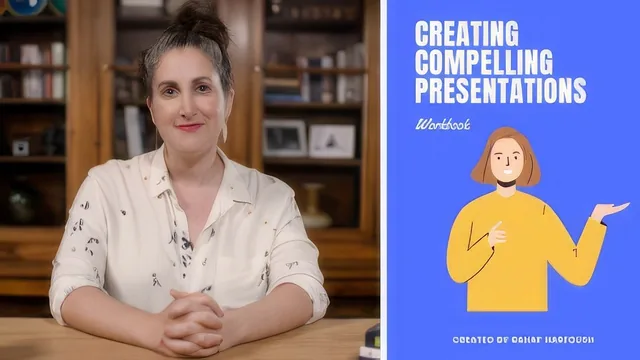
A 25-minute framework of five worksheets that turns presentation prep from guesswork into a repeatable process before you ever open a slide deck.
A prep framework, not a delivery class
Rahaf Harfoush's course is narrower than its title suggests. It is not about how to stand and speak in front of a room, it is about the planning that happens before anyone opens a laptop. Across eight short lessons, the course walks through a sequence of worksheets, an audience profile sheet, a core objective sheet, a "designing for context" sheet, a presentation aids sheet, and a compelling story sheet, that together form a single planning framework meant to be reused for any future presentation. The final lesson is explicit that tone of voice, pacing, and posture are saved for a follow-up class. Anyone expecting stagecraft advice will be disappointed; anyone who has ever frozen at a blank slide deck with no idea where to start will find real value here.
The strongest material comes early. The audience profile exercise, filling in purpose and needs separately for a CEO, a manager, and a team when presenting the same marketing update, is a clean, specific illustration of a point most presentation advice only gestures at. The objective sheet goes a step further by adding a "subtle professional positioning" box, a private note on what the presenter personally wants from the moment, whether that's looking like a good problem-solver or building a case for promotion. It is a small addition, but it reframes a presentation as a career tool rather than just an information transfer, which fits the course's stated hook about advancing professionally.
The context-and-aids sections are where the course gets genuinely practical. The three-way split between a presenting deck, a meeting aid, and a send-after deck directly targets the most common failure mode in business presentations: slides packed with paragraphs that the presenter then reads aloud. Harfoush demonstrates this with a short mental-health statistics example, delivered once as spoken narration and once as a text-heavy slide, to show how a dense slide pulls attention away from the speaker rather than supporting them. It's a simple demonstration, but it lands because it's concrete rather than aspirational.
The closing lesson on story structure, mapping a presentation to a problem, a search for solutions, and a resolution, then layering in an emotional cue for each stage, is useful but thinner than the earlier material. It reintroduces a widely known storytelling formula without pushing much past the basics, and it leans on the same marketing-campaign example used throughout the course, which starts to feel recycled by the eighth lesson.
The course's real limitation is scope. At 25 minutes, it cannot be both a planning framework and a delivery guide, and it openly chooses the former. Viewers who already have solid structuring instincts and are looking for stage presence, vocal variety, or handling live audience interaction will find nothing here. But for someone who habitually opens PowerPoint first and figures out the message as they go, the worksheet sequence offers a genuinely different, more disciplined starting point. It is a course best measured by whether the printed workbook actually gets used on a real upcoming presentation, not by how compelling the video itself is to watch.
The standout
The three-deck distinction, presenting deck, meeting aid, and send-after deck, forces a concrete fix for the single most common slide mistake: cramming a script onto a screen meant to support a speaker, not replace one.
What you will learn
- Build an audience profile that separates purpose and needs by who you're addressing (CEO, manager, team)
- Set a core objective plus a private 'subtle professional positioning' goal for each presentation
- Adjust content and pacing for time constraints, physical space, and level of interaction
- Distinguish a presenting deck, a meeting aid, and a send-after deck so slides don't do double duty as a script
- Prepare a bank of backup slides for anticipated questions
- Structure a talk as a problem-search-success story with an emotional arc mapped to each section
Best for: Someone who already has a real presentation coming up and wants a structured worksheet-driven process to prepare it, not performance coaching.
Skip it if: Anyone hoping to improve stage delivery, vocal tone, body language, or nerves, since the course stops at prep and defers delivery to a separate class.