
Personal Brand Manifesto: Who Do You Think You Are?
Adam J. Kurtz · Artist, Author
Five weird physical exercises in 35 minutes force you to confront what you actually value, no drawing skill required.
An emotional exercise wearing a branding title
The title promises a personal brand manifesto, but the course is not about branding in any conventional sense. There is no discussion of positioning, visual identity, audience, or messaging. Instead, Adam J. Kurtz leads five short physical exercises meant to reconnect a burned-out creative person with their own values, and the "manifesto" that results is an envelope full of paper scraps, not a document or a strategy.
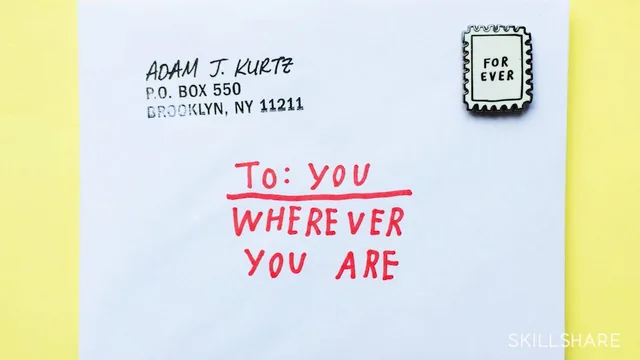
The structure is simple and holds together well for something this short. It opens with a list titled around what the participant cares about, moves into a scribbling exercise meant to physically embody thankless work, then a tearing exercise that breaks a daunting stretch of time or a big project into small pieces, then a reframing of a dollar bill as raw material to question ideas of worth, and finally the surrender of a personal memento to simulate the vulnerability of putting work into the world. Each piece goes into a sealed envelope, which becomes the tangible object the course is built around producing.
The tearing exercise is the strongest moment in the course. Turning a blank page into a timeline and physically ripping it into chunks (today, this week, next year, three years out) gives a genuinely useful way to shrink an overwhelming future into something that feels survivable, and it is easy to repeat on your own after the class ends.
What it delivers and what it does not
The course is honest about what it is. It is closer to a guided pep talk or a piece of art therapy than a skill-building class, and it says so directly rather than overselling itself as instruction. For someone who is exhausted, unfocused, or questioning why they do creative work at all, that emotional reset has real value, and the physical, tactile nature of the exercises (scribbling until a hand cramps, tearing paper into confetti) makes the reflection concrete instead of abstract.
Where it falls short is in the gap between the title and the content. Someone arriving expecting help articulating an actual personal brand statement, tagline, or creative direction will find nothing of the sort. The exercises are also light on structure for anyone who wants more than a single pass through the materials, since there is no framework for revisiting the values list beyond a suggestion to repeat the whole ritual again in a few years. The memento exercise, giving away something personal and sealing it away, also asks a lot emotionally for very little explained payoff beyond the metaphor itself.
At 35 minutes, the course does not overstay its welcome, and its low production demands (paper, a pen, a dollar bill, a keepsake) mean anyone can do it immediately without preparation. It works best as an occasional reset rather than a course to be studied, and it succeeds on those narrow terms even though the branding framing oversells what it actually is.
The standout
The tearing exercise, which turns a blank sheet into a physical timeline you rip apart piece by piece to make an overwhelming stretch of time or a daunting project feel survivable.
What you will learn
- How to distill your core motivations into a short, ranked personal values list
- A physical release technique (scribbling until your hand cramps) for processing burnout
- A paper-tearing exercise to break an overwhelming timeline or project into small, manageable chunks
- How to reframe money as a neutral material to challenge your relationship with value and worth
- A ritual for giving up a personal memento to practice the emotional cost of sharing your work publicly
- How to compile all five artifacts into a single sealed keepsake that documents where you are right now
Best for: Freelancers, solo creatives, and early-career makers who feel burned out or unmoored and want a fast, low-stakes emotional reset rather than a business or portfolio skill.
Skip it if: Anyone looking for concrete personal branding strategy, marketing tactics, or design instruction should skip this and find a course that actually covers positioning, visual identity, or audience growth.