
Painting with Thread: Modern Embroidery for Beginners
Danielle Clough · Embroiderer
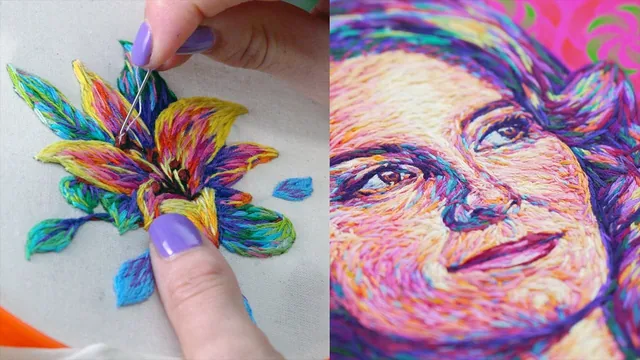
A genuinely warm, technique-rich beginner class that trades photorealistic precision for expressive color blending, ideal for anyone who wants permission to break embroidery's rules.
Danielle Clough's "Painting with Thread" sells itself as a rule-breaking take on embroidery, and it mostly delivers on that promise. Rather than drilling a fixed stitch vocabulary in isolation, the course builds toward one real, finished object: a color-blended floral piece made from a photo the student takes themselves. That throughline, from a photograph on a phone to a laced and framed hoop, is the course's strongest structural decision, since it gives every lesson a visible destination instead of a disconnected list of techniques.
What the course actually teaches
The early lessons cover the expected fundamentals: fabric choice (natural linens and cottons, always pre-washed), needle types, hoop tensioning, and thread weight, down to the detail of splitting six-strand floss into finer twos and ones for detail work. From there, five stitches carry the entire class: back stitch for outlines, couching for holding down loose thread lines, satin stitch for flat fills, long-and-short stitch for shaded fills, and the French knot for texture. Each gets a short, hands-on demonstration rather than a drawn-out breakdown, which keeps the pace brisk but occasionally rushed, since the shift from one stitch to the next depends on the viewer replaying and pausing to catch the needle placement.
The color-blending method is where the course earns its title. Working from a photograph edited into both a saturated and a black-and-white version, the piece is built in passes: shadow tones first to rough in the composition, then midtones filling in bulk coverage with thicker six-strand floss, then highlights and fine detail worked in singles. A neat closing trick, twisting two different-colored threads through one needle to create an instant blend, extends the technique further and is genuinely useful for anyone chasing gradient effects without constant re-threading. The reference-photo and carbon-paper transfer lessons round out the practical skill set, covering both digital tracing on a phone and old-fashioned carbon transfer onto fabric.
Strengths and shortcomings
What makes the class distinctive is its permission-giving tone. Rather than insisting on a tidy back or an exact color match to the reference, the instruction repeatedly encourages improvisation: adding an unplanned color because it "feels right," fixing mismatched stitches by working over them, and treating the back of the piece as a working record rather than something to hide. For anyone intimidated by embroidery's reputation for precision, that framing does real work in lowering the barrier to starting.
The tradeoff is technical rigor. Stitch instructions are demonstrated once, quickly, and largely by feel, with few close-up repeats or slow-motion breakdowns for anyone struggling to replicate hand position. There's no stitch glossary or reference sheet to return to, so a beginner who missed the French knot wrap count on first viewing has to scrub back through footage rather than consult a clean summary. A closing lesson on experimental surfaces (embroidering onto tennis rackets and other found objects) is more inspirational than instructional, offering ideas rather than a repeatable method.
The finishing lesson on lacing a piece into a display hoop is a welcome, often-overlooked addition, and the explicit warning against using glue on archival work is a small but genuinely useful piece of craft knowledge. Overall, this is a strong choice for someone who wants to be eased into embroidery with a real finished piece and a loose, expressive style, but a poor fit for anyone who wants a precise technical reference they can follow stitch by stitch without rewatching sections repeatedly.
The standout
The long-and-short stitch color-blending sequence, where shadow, midtone, and highlight tones are layered in stages to create a photographic gradient entirely by hand.
What you will learn
- Thread a needle, tie a quilter's knot, and set up a hoop with proper fabric tension
- Execute five core stitches: back stitch, couching, satin stitch, long-and-short stitch, and French knots
- Blend thread colors using variegated floss and the two-thread needle-blending technique
- Shoot and edit a personal reference photo (including a black-and-white version) for color planning
- Transfer a design to fabric using tracing paper and carbon paper
- Build color depth in layers, working shadows to midtones to highlights, then finish and lace a piece into a display hoop
Best for: Total beginners who want a relaxed, intuitive entry into embroidery and are more interested in expressive color work than in precise, traditional technique.
Skip it if: Anyone seeking rigorous technical instruction in classic embroidery stitches, exact counts, or a tidy stitch-by-stitch reference guide, since the teaching is loose and demonstration-led throughout.