
Painting with Gouache Made Fun & Easy! A Beginners Guide to Learn Modern Paint Techniques
Yasmina Creates · Artist & Creativity Cheerleader
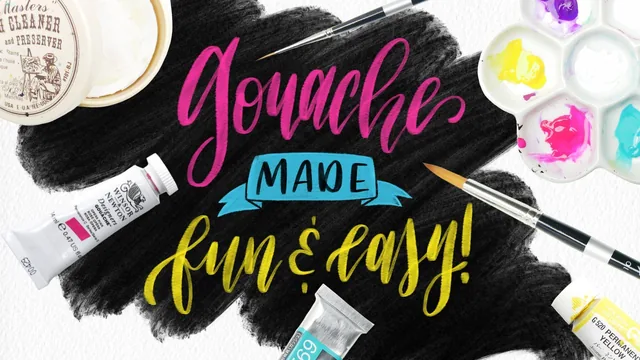
A fast, practical gouache primer that trades depth for speed, best for absolute beginners who want to start painting today.
What the course actually covers
This is a compact, conversational walkthrough of gouache fundamentals, built around one core tension the medium presents: paint is opaque enough to layer like acrylic, yet stays water-reactivatable forever, meaning every new stroke can accidentally lift the one underneath. Nearly every lesson circles back to that problem. The supplies lesson goes further than most beginner classes bother to, distinguishing artist-grade from designer-grade gouache (fugitive versus permanent pigments), explaining why titanium white differs from zinc white in use, and recommending a cyan-magenta-yellow primary set over the more common red-yellow-blue because it mixes a wider color range. It is opinionated in a useful way rather than vague.
The flow-and-opacity lesson is the practical core of the class. Paint straight from the tube, paint with a few drops of water, and paint as a thin wash are each demonstrated on the same page, on both white and black paper, so the visual difference is unmistakable rather than described in the abstract. That lesson alone does most of the heavy lifting for anyone new to the medium.
Where it delivers and where it thins out
The three-spheres exercise is the strongest teaching moment in the course. The same round shadowed form gets painted three times: once loose and wet, once with moderate water for softer blending, once dry and layered for a smoother, more realistic finish. Seeing one subject rendered three distinct ways clarifies what changes when water ratio changes far better than a verbal explanation would.
The final live landscape demonstration, built from a reference photo with sky, hills, a tree, and a small red barn, ties the individual techniques into one finished piece, walking through wash backgrounds, wet-in-wet clouds, and small detailed elements like windows and a fence that require careful, low-water paint control. It is a satisfying capstone that shows the techniques working together rather than in isolation.
The class runs just over an hour, and the pacing shows it. Color mixing gets almost no direct instruction beyond naming a primary set, and the course repeatedly defers to the instructor's separate watercolor and color-mixing classes rather than covering that ground itself. For an absolute beginner starting from zero, that gap matters, since color mixing and paint-to-water ratio are the two skills gouache actually hinges on. The advanced tips lesson is also thinner than its name suggests, mostly a list of quick asides (ox gall for slower drying, combining gouache with ink or colored pencil, storage advice) rather than techniques that would meaningfully extend a beginner's range.
Verdict
As an introduction to a genuinely underexplained medium, the course succeeds at its narrow goal: it demystifies why gouache behaves differently from watercolor and acrylic, and it gives a beginner enough hands-on practice, through the wet-in-wet flower exercise and the landscape demo, to start experimenting immediately. It is not a substitute for a color theory class or a technique-heavy deep dive, and anyone who already understands paint-to-water ratios from watercolor work will find much of it familiar. For someone who has never opened a tube of gouache, though, it is an efficient, well-organized starting point.
The standout
The three-spheres exercise, where the same shadowed sphere is painted three separate ways (loose wet-in-wet, medium water, and dry layered) side by side, does more to teach blending control than any single explanation could.
What you will learn
- How to judge paint quality and choose a starter palette (Holbein primary set, cyan/magenta/yellow logic)
- How to control the water-to-paint ratio for opaque, semi-opaque, and wash consistencies
- How gouache reactivates when wet and how to layer without disturbing lower layers
- Multiple blending approaches, from loose wet-in-wet to tight dry layering, demonstrated on spheres
- Advanced tricks like using ox gall to slow drying and combining gouache with ink or colored pencil
- How to build a finished landscape painting from a light wash base to detailed final layers
Best for: A total beginner to gouache, especially one who already has some watercolor experience and wants a clear, low-jargon on-ramp.
Skip it if: Anyone with intermediate gouache experience already comfortable with layering and water ratios, or anyone wanting rigorous color theory or a structured multi-week skill-building path.