
painting watercolor seascapes
Erin Kate Archer · art & illustration
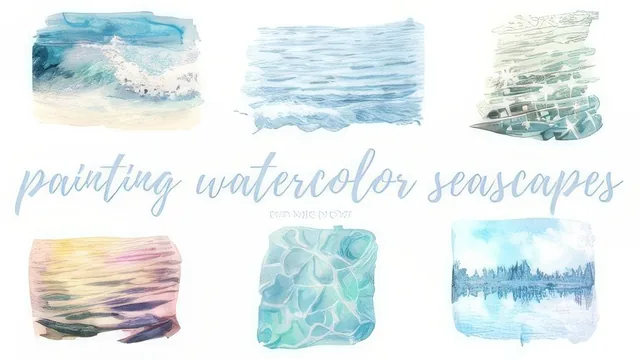
A tight, technique-dense 101 minutes that teaches wave anatomy and layered watercolor studies but assumes you can already handle a brush.
What it actually covers
The course opens with a short but genuinely useful anatomy lesson: crest, trough, wavelength, wave height, calm sea level, direction of travel. It is a small vocabulary, but naming these parts before picking up a brush gives every later demonstration a shared reference point, and Archer returns to those terms constantly when describing where shadows and highlights belong. The supply and color-swatching lessons that follow are brief and practical rather than exhaustive: one core blue, plus warm and cool yellow mixed in to swing toward teal or true green, plus a slate gray for shadow work. It is a deliberately small palette, and the class leans on it hard through every subsequent lesson.
The bulk of the runtime is a sequence of studies moving from highest to lowest energy water: crashing waves and white caps, then sparkling water and a sunset reflection, then tropical water and a fully calm reflection. Each study repeats the same underlying process (masking fluid or reserved white space, base color layers, shadow layers, then gouache and white pen detailing) applied to a different water condition. This repetition is the course's real teaching method: rather than explaining a rule once, it shows the same shadow-and-highlight logic four or five times against different subject matter, which is how the underlying pattern actually sinks in.
Strengths and limits
The masking fluid guidance is more specific than most watercolor classes bother with: dab dots rather than solid blocks so foam keeps some transparency, use a colored fluid so you can see where you've applied it, and clean brushes immediately since dried fluid ruins bristles. The white cap perspective lesson is the strongest single stretch of the class, walking through how strokes should shrink, flatten, and lose saturation as water recedes toward the horizon, which is a concrete, transferable rule rather than a vague suggestion to "add some detail."
Where the course is thinner is pacing and beginner accessibility. Instructions move at demonstration speed, brush choices and water ratios are described in passing ("a little bit too wet," "not so wet") rather than with concrete ratios, and someone who hasn't already practiced wet-on-wet control will likely struggle to keep up during the final full painting. The final project lesson itself is really a continuation of the same techniques at larger scale rather than new material, so anyone hoping for a distinct capstone concept beyond what the studies already covered will find the transition seamless to the point of being repetitive.
As a whole, this is a tightly scoped skills class rather than a broad watercolor course. It does not teach composition, drawing fundamentals, or general watercolor control, and it says so implicitly by moving straight into wave-specific work. For someone who already has basic watercolor mileage and wants a repeatable framework specifically for painting convincing ocean water, foam, and reflected light, it delivers exactly that, efficiently and without padding.
The standout
The perspective technique for open water, shrinking, flattening, and desaturating white caps toward the horizon while keeping the foreground wave large and saturated, is the single skill most likely to fix amateur seascapes.
What you will learn
- Naming and sketching wave anatomy (crest, trough, wavelength, wave height) as a planning step before painting
- Using masking fluid strategically (dotted, not solid) to preserve white foam and sparkle highlights
- Mixing a small core palette (bright blue, warm/cool yellow, slate gray) into teal, green, and shadow tones
- Building depth and perspective in water through size, saturation, and detail gradients from foreground to horizon
- Layering wet-on-wet and wet-on-dry washes to create foam, sparkle, and reflection patterns with a round and square brush
- Finishing with white gouache and a white gel pen for sea spray, foam edges, and refracted light details
Best for: Intermediate watercolorists who already know basic wet-on-wet and wet-on-dry control and want a focused vocabulary and workflow specifically for painting moving water.
Skip it if: Total beginners who haven't handled masking fluid or a round brush before, since supply and technique explanations move quickly and assume prior comfort.