
Painting Light and Shadow: The Basics for Portraits and Characters
Gabrielle Brickey · Portrait Artist - ArtworkbyGabrielle.com
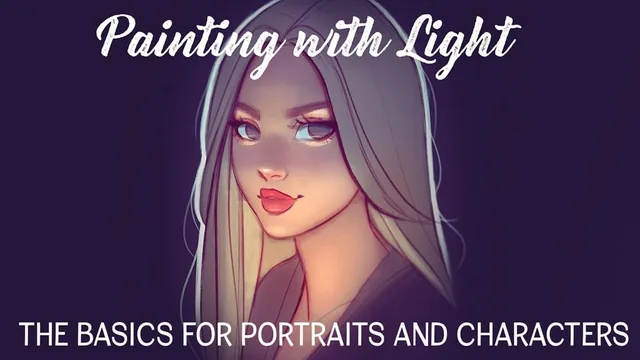
A working portrait artist's practical shorthand for lighting faces, strong on observable patterns but light on underlying color science.
This course tackles one of the hardest problems in portrait and character work: not drawing a face, but lighting one convincingly. It assumes the viewer can already render a likeness and focuses entirely on what happens when light hits that structure. The teacher is upfront that this is an observational, artist's-eye approach rather than a lesson in optics, and that framing shapes everything that follows.
Structure and core teaching
The course opens with vocabulary that recurs throughout: color temperature, local color, value, and the split between direct and diffuse light sources. From there it moves into the planes of the head, a simplified geometric reading of the forehead, nose, cheekbones, and mouth that turns a complex 3D surface into manageable flat facets. This section is the backbone of the whole course, because every later lesson (skin tones, lighting angles, blending) refers back to how a given plane catches or loses light.
The middle stretch covers skin tone mixing (with a specific pigment recipe of cadmium red, yellow ochre, titanium white, and blue), then walks through common light sources: direct sun, overcast sky, and the color-temperature flip that happens when a subject's back is to the sun, so the upward-facing planes read cool from the sky and the downward-facing planes read warm from the ground. Named lighting angles like butterfly, loop, split, rim, and an invented "nose pop" pattern are demonstrated on both real faces and characters, giving a small, reusable catalog of setups rather than one all-purpose formula.
Techniques and demos
The blending lesson is genuinely cross-medium, showing how to soften plane transitions in Photoshop by color-picking between two values, in Procreate with a soft pastel smudge brush, in oils by dragging a brush between adjacent tones, and in Copic markers by working strictly light to dark. The later demo videos put this into practice across four character lighting scenarios and several realistic portrait paintings, narrating decisions in real time, including moments of trial and error like adjusting a highlight's position after realizing it should sit closer to the light source.
Where the course is strongest is in pattern recognition: once a learner internalizes the plane breakdown and the handful of named lighting scenarios, those shapes are described as transferring reliably from one face to the next, which is a genuinely useful compression of a huge topic. Where it falls short is depth on anything outside the observational method. The science of light is explicitly waved off in the second lesson, so a student wanting to understand why these patterns hold, rather than simply recognizing them, will need to look elsewhere. The smaller forms of the face and some of the more advanced lighting effects, like subsurface scattering and dappled light, are treated briefly.
The class project is straightforward and appropriately scaffolded, moving from a simple sphere study to painting one character under four different lighting setups. That progression makes the course feel complete rather than a loose collection of tips, and the reference-reading lesson near the end, which walks through interrogating a photo for its light source, direction, and temperature before painting, is a practical habit that extends well past the exercises here.
The standout
The planes-of-the-head breakdown, paired with the upward-plane/downward-plane color-temperature rule (cool from sky, warm from ground), gives a repeatable framework for reading any lighting scenario.
What you will learn
- How to break the head into planes (forehead, nose, cheekbone, mouth) to simplify where light falls
- The vocabulary of light and shadow on form: highlight, halftone, terminator, core shadow, cast shadow, occlusion shadow, reflected light
- How color temperature shifts between light and shadow depending on the light source (warm sun vs cool sky fill)
- Several named lighting angles (butterfly, loop, split, rim, nose pop) and how to place them on a face or character
- Blending techniques across markers, oils, pastels and digital tools (Photoshop color-picking, Procreate smudge)
- How to read and analyze a reference photo for light source, direction, and color temperature before painting
Best for: Intermediate portrait or character artists who already draw faces reasonably well but paint lighting inconsistently or by guesswork.
Skip it if: Absolute beginners who haven't yet practiced basic portrait drawing, or anyone wanting the physics of light explained rather than an artist's observational shorthand.