
Narrative Art: Drawing Imaginary Characters
Ira Marcks · Graphic Novelist
A history-heavy foundation in what makes cartoon characters feel alive, but light on hands-on drawing instruction until the final third.
A history lesson before a drawing lesson
Ira Marcks structures this course like a pyramid, and he says so directly: art history and theory at the base, Disney's animation principles in the middle, and a hands-on illustration project at the top. That means the first third of the 110 minutes is dedicated almost entirely to narrative art history, tracing character-driven storytelling from Greek vase paintings of satyrs and King Croesus through Thomas Cole's Voyage of Life paintings, Goya, Winslow Homer, and Frida Kahlo, before finally arriving at cartooning with Winsor McCay's Gertie the Dinosaur and the founding of Disney's character design philosophy. It is a genuinely interesting survey, and Marcks draws real connections, such as pointing out that Ariel's pose in The Little Mermaid echoes Georges de La Tour's Magdalene painting. But viewers who came for pencil technique will need patience, since none of this section involves drawing.
The middle section is where the course earns its keep. Marcks walks through the core principles from Disney's foundational text The Illusion of Life: squash and stretch, character appeal, believability, and staging. His explanation of squash and stretch as physics rather than distortion, comparing a character's eye to a water balloon with a weighted center that pulls and returns, is a clear and useful mental model. The staging lessons are similarly strong, using a page from Jessica Abel and Matt Madden's book to show sixty variations on how camera angle, horizon tilt, and character blocking change the emotional read of the same two-person scene. This is the most transferable material in the course, applicable to comics, illustration, or animation alike.
The project section, and its limits
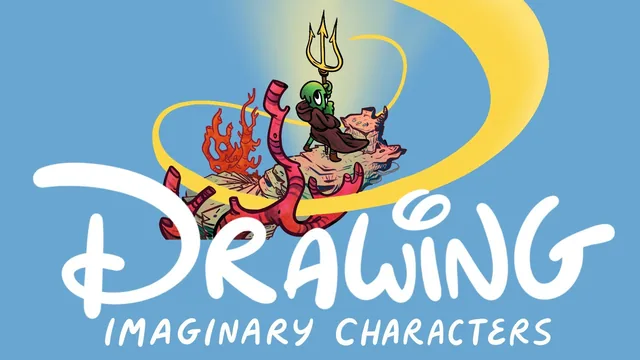
The class project follows Marcks designing an original character, a merman named Gill pulling a trident from a cursed reef, structured as a riff on the sword-in-the-stone myth. He narrates his process from concept sketch through inking to digital coloring in Clip Studio Paint, including practical touches like using the skew tool to push a composition toward a vanishing point, and layering shadows with color burn blend modes tied to specific layers. This is valuable to watch as a demonstration of professional workflow and decision-making, but it is a demonstration more than a lesson. Marcks explains his own choices rather than teaching foundational figure drawing, proportion, or anatomy, so viewers without existing drawing skills will struggle to replicate the results.
The course also leans heavily on Disney film examples, including Peter Pan, 101 Dalmatians, Alice in Wonderland, and Sleeping Beauty, alongside a brief but well-chosen look at Studio Ghibli's Princess Mononoke and My Neighbor Totoro. This breadth is a strength for anyone wanting to understand character design as a discipline with a long visual history, but it also means the course sometimes reads more like a film studies lecture with drawing exercises attached, rather than a drawing course with historical context added. Anyone expecting a bouncing-ball-style animation exercise or step-by-step anatomy breakdown should look elsewhere. For illustrators who already have pencil control and want a richer vocabulary for why their characters do or do not feel alive, the theory pays off, and the final class project offers a useful template for approaching a personal character illustration with real narrative intent.
The standout
The five-step composition-planning order (concept, emotional energy, overall appeal, character pose, point of view) gives a repeatable checklist for starting any character illustration with intention instead of guesswork.
What you will learn
- How to trace narrative art's lineage from Greek vase painting through Thomas Cole and Disney to modern animation
- How the squash and stretch principle distributes a character's volume to convey physical reaction and emotion
- How to build character appeal through silhouette and small design details rather than generic cuteness
- How to stage a character's body language, camera angle, and horizon line to control audience perspective and tension
- How to plan a finished illustration in order of priority: concept, emotional energy, composition, character pose, and environment
- How to build a restrained color palette and layer shadows and highlights digitally to give a scene mood and depth
Best for: Illustrators and cartoonists who already sketch but want a theoretical framework for why certain character designs feel alive and want to see a full concept-to-color workflow demonstrated.
Skip it if: Absolute beginners looking for step-by-step figure drawing or anatomy instruction, since the course assumes basic drawing ability and spends much of its runtime on art history and theory rather than technique drills.