
Modern Watercolor Wreaths : 3 Ways
Amarilys Henderson · Watercolor Illustrator, Design Thinker
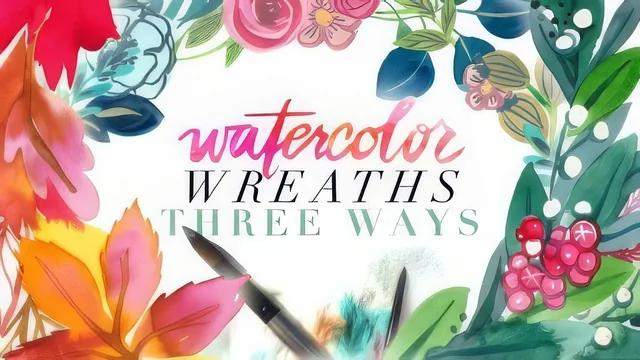
A focused 46-minute sequel that teaches three distinct wreath-building methods for painters who already know basic watercolor florals.
Modern Watercolor Wreaths: 3 Ways is a direct continuation of Amarilys Henderson's earlier florals class, and it treats that relationship as a prerequisite rather than a suggestion. The class spends its first three short lessons on brush behavior and basic leaf shapes before ever mentioning a wreath, then dedicates three-lesson blocks to each of three named styles: a dropped wreath in autumn tones, a vintage wreath, and an illustrative Christmas wreath. That structure, prep, form, definition, repeated three times, gives the course a clear rhythm and makes it easy to skip to whichever style suits a viewer's taste.
What actually gets taught
The dropped technique relies on concentrated liquid watercolors like Ph. Martin's, applied wet-on-wet so leaves bleed into each other with minimal control. The instruction to leave gaps between wet elements so colors do not run together unintentionally is a genuinely useful, specific piece of troubleshooting advice, not filler. The vintage technique is more technically interesting: tube watercolor gets mixed with white acrylic ink to create a semi-opaque paint that can be built from dark background layers to light foreground details, a working method distinct from standard transparent watercolor. The illustrative technique closes the course with masking fluid to preserve white paper, followed by a wet-and-dry layering approach that moves from large loose brushstrokes to small refined ones.
Throughout, the compass-drawn circle as a layout guide and the advice to distribute focal colors and shapes around the ring for rhythm are the closest things to universal wreath-composition principles the course offers. These ideas would apply to any circular arrangement, not just watercolor.
Where it comes up short
At 46 minutes across 13 lessons, several lessons run only a few minutes, and the course leans heavily on the assumption that viewers already know the underlying wet-on-wet and blending mechanics from the first class. Someone arriving without that foundation will find explanations thin, since core technique justification is deferred to "the first class" rather than repeated here. The pacing also favors demonstration over instruction: much of the runtime is Henderson narrating her own choices in real time rather than issuing replicable steps, which suits viewers who learn by watching a process unfold but frustrates those wanting a checklist.
The course also never resolves into a single finished project brief. There is no material list handout, no template, and no structured critique or peer-sharing prompt beyond a general invitation to share results. For a class this short, that is a reasonable trade-off, but it means the value is concentrated entirely in watching three techniques applied rather than in a scaffolded assignment.
Overall, this is a tight, well-organized follow-up that rewards someone who enjoyed the first florals class and wants the same three approaches applied to a new shape. It is not built to teach watercolor fundamentals, brush control, or color theory from scratch, and viewers expecting that will be better served by the earlier class first. Taken on its own terms, as a focused technique extension, it delivers exactly what it promises in under an hour.
The standout
The vintage wreath's technique of mixing white acrylic ink directly into tube watercolor to build a semi-opaque, dark-to-light layering system is the most distinctive and transferable skill in the class.
What you will learn
- How to arrange loose floral shapes into a symmetrical wreath composition using a compass-drawn circle guide
- The wet-on-wet dropped technique using concentrated liquid watercolors for bleeding, blended fall foliage
- The vintage semi-opaque technique of mixing tube watercolor with white acrylic ink for muted, structured florals
- The illustrative wet-and-dry technique combining masking fluid, layered glazing, and fine detail brushwork
- How to sequence overlapping elements (background first, focal points last) so a wreath reads as connected rather than scattered
- How brush choice and hand pressure change leaf and line quality across round, liner, and filbert brushes
Best for: Painters who already finished the instructor's first florals class and want to apply those same three styles to a circular, symmetrical composition.
Skip it if: Absolute beginners to watercolor who have never practiced basic wet-on-wet blending or brush control, since the class assumes that foundation is already in place.