
Modern Flowers: Arranging a Stunning Centerpiece
Michael + Darroch Putnam · Founders, Putnam Flowers
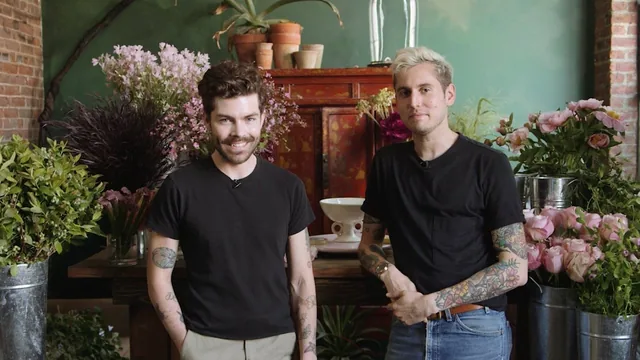
A tight 48-minute masterclass in one signature technique, chicken wire structuring, but it teaches a style, not a system.
A short, dense demonstration rather than a curriculum
Michael and Darroch Putnam, the founders of Putnam & Putnam, use their 48 minutes efficiently. The class follows one continuous build from an empty bowl to a finished, table-ready centerpiece, and every lesson maps directly onto a step of that build: selecting product, prepping stems, prepping the vessel, then three layered arranging passes. There is no wasted preamble and almost no theory divorced from the physical work in front of the camera. That focus is the course's biggest strength and also the source of its main limitation: it teaches one arrangement, in one style, and expects the viewer to generalize from it.
The structural backbone of the class is the chicken-wire armature, and it is taught with real specificity. The Putnams show how to cut wire roughly twice the diameter of the vessel opening, ball it up, dome it slightly rather than let it sit flat on the bowl's bottom, and tape it in with an X so stems pass through two layers of wire before reaching water. This is presented explicitly as an alternative to floral foam, and the reasoning given, that a single flat layer of wire only provides one point of stability, is the kind of concrete mechanical detail that separates a real technique from a vague tip.
Flower processing gets similarly granular treatment. Roses are opened faster with warm water and stripped of lower leaves and thorns; tulips and ranunculus go straight into cold water because their softer stems turn mushy in heat; peonies get a warm-water soak or steam treatment to break down their natural sugar coating. Each technique is tied to a stated reason, water flow, bacteria growth, stem hardiness, so the instructions read as principles that transfer to other flowers rather than a rote checklist for these exact stems.
Where the design thinking lives, and where it thins out
The arranging sequence itself is built around a clear compositional logic: establish an asymmetrical crescent shape with foliage, fill with a neutral filler flower worked evenly throughout, then introduce specialty blooms in color-based concentrations rather than scattering them evenly. The instruction to vary stem length for depth, to stagger flowers in odd-numbered clusters instead of straight lines or perfect triangles, and to leave negative space that later frames a small delicate bloom, are all specific, repeatable design moves that a viewer can lift directly.
The color methodology is the more abstract half of the class. The Putnams describe starting from one inspiration flower and buying outward from both ends of its color range, but this is demonstrated through running commentary during shopping rather than through any structured framework, so it depends heavily on having an eye already somewhat trained. A first-time arranger may absorb the vocabulary, dark side, light side, transition, without yet having the instinct to execute it independently.
The course also assumes access to a well-stocked flower market and a fairly generous budget, given the range of peonies, clematis, ranunculus, and specialty foliage on the table, though the Putnams do offer a scaled-down version: one base green, one star flower, one filler, and a texture element for anyone starting small. That concession keeps the class from feeling entirely out of reach, but it remains a supplementary note rather than a fully worked parallel example.
Overall, this is a well-organized, technically grounded look at professional floral construction that rewards someone who already owns basic shears and has arranged flowers before. It is not a beginner's first flower class, and it does not pretend to be.
The standout
The chicken-wire armature method, built as a domed ball taped into the vessel so stems anchor through two layers instead of resting flat, is a genuinely reusable structural technique that replaces floral foam.
What you will learn
- How to build a self-supporting chicken-wire armature inside a footed bowl instead of using floral foam
- How to select and process different flower types (roses, tulips, ranunculus, peonies) for maximum vase life
- How to build an arrangement in layers: base foliage, filler, specialty flowers, then texture and gestural accents
- How to plan a color story around one inspiration flower and transition it across a light-to-dark spectrum
- How to create depth and asymmetry by varying stem length and avoiding flat, single-plane placement
- How to finish and adapt an arrangement for one-sided display, double-sided display, or a full table setting
Best for: Someone who has arranged flowers before and wants a professional's structural and color-transition method for a single dramatic centerpiece.
Skip it if: Total beginners with no flower-market access or budget for a dozen varieties, and anyone wanting a rigid formula rather than an intuitive, feel-it-out process.