
Modern Crochet: Essential Skills for Getting Started
Toni Lipsey · Modern Crochet Design for the Adventurous Beginner
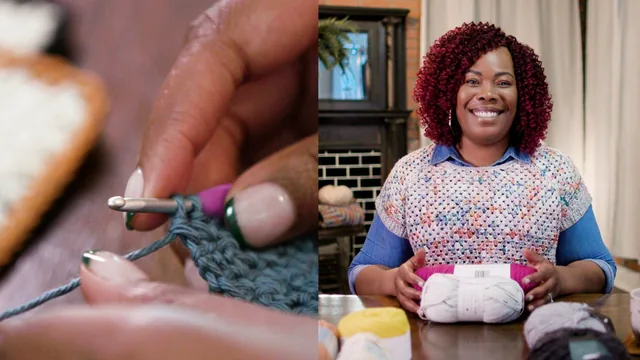
A gentle 91-minute crash course that trades stitch-count breadth for genuinely useful lessons on yarn, color, and finishing that most beginner classes skip.
Toni Lipsey's beginner crochet class sets out to do one thing: take someone who has never held a hook and walk them all the way through a finished, polished object. The chosen project, a set of four cotton coasters, is small enough to finish in a sitting but layered enough to touch on nearly every foundational skill a new crocheter needs. That scope, rather than stitch variety, is the course's real value.
A logical build, not just a stitch tutorial
The class opens with two lessons most beginner tutorials skip entirely: yarn selection and color theory. Lipsey walks through reading an actual yarn label, explaining fiber content, weight numbers on the 0 to 7 scale, and why lot numbers matter for larger projects, then breaks down animal, plant, and synthetic fibers by how they drape, wick moisture, and hold their shape. The color theory lesson covers complementary, triadic, analogous, and monochromatic palettes using a simple color wheel made of yarn cakes. Neither lesson is essential to finishing the coasters, but both give a beginner language and judgment they will reuse on every future project, which is more than most quick-start classes bother to offer.
The technical core is compact: a slipknot, a foundation chain, a single crochet, and a double crochet, alternated within the same row to create texture. Lipsey is precise about hand mechanics, tension, and where to insert the hook, including a genuinely practical trick of using a locking stitch marker to flag the last stitch of a row so beginners do not lose count. The border lesson that follows is where the project starts to look intentional, teaching how to place two stitches around a double crochet post versus one around a single crochet, a small distinction that determines whether an edge looks clean or sloppy.
Where the class goes further, and where it stops short
The color lessons on blocking and striping are a nice bridge from "I can make one thing" to "I can start making decisions," showing how to change colors mid-stitch without a visible seam and how to manage yarn floats when carrying a second color up the side of a piece. The blocking lesson, near the end, is arguably the most valuable single stretch: pinning damp coasters to a foam grid and applying steam transforms curling, uneven squares into flat, crisp shapes, and the visual before-and-after comparison makes the case for a step many beginners are tempted to skip.
What the course does not do is expand the stitch vocabulary beyond single and double crochet, so anyone hoping for half doubles, treble crochet, or shaping techniques like increases and decreases for garments will need a second class immediately after this one. The pacing also assumes patience during the yarn and color lessons before any yarn touches a hook, which may frustrate someone who wants to start stitching in the first five minutes.
For its stated audience, though, the structure works. It does not just produce a coaster, it produces a crocheter who understands why the coaster looks the way it does, and that framing is worth more than the object itself.
The standout
The blocking lesson, where pinning a damp piece to a foam grid and steaming it turns a curling, uneven square into a crisp, professional-looking coaster.
What you will learn
- Reading a yarn label for fiber content, weight, and dye lot, and choosing cotton over acrylic or wool for a given project
- Building complementary, triadic, analogous, and monochromatic color palettes using a color wheel
- Working a slipknot, foundation chain, single crochet, and double crochet with correct tension
- Alternating single and double crochet stitches in the same row to build a textured square
- Adding a single crochet border around a finished piece, including turning corners cleanly
- Changing colors mid stitch for color blocking and stripes, and blocking a finished piece with pins, steam, and a foam mat
Best for: A true first-time crocheter who wants one complete, well-finished project and the underlying logic of yarn and color, not just a stitch tutorial.
Skip it if: Anyone who already knows single and double crochet and wants new stitches, garment construction, or advanced techniques like Tunisian crochet.