
Marks & Moods: Brush Pen Adventures with Lines and Textures
Marie-Noëlle Wurm · Artist, illustrator, HSP
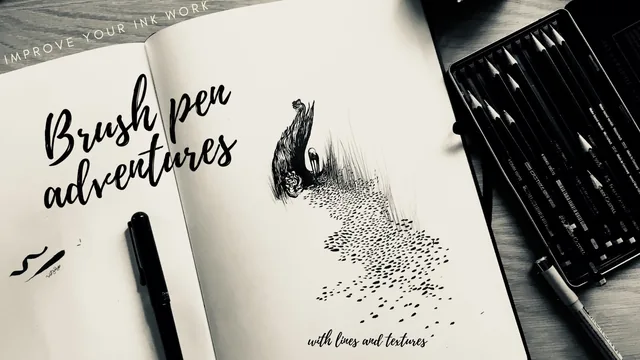
Thirty-four minutes of brush pen exercises that teach you to see marks as mood, not just technique drills.
Marks & Moods is a short, tightly scoped class about one tool: the brush pen. It does not try to teach drawing, composition, or illustration from scratch. Instead it isolates a single question, how many different marks can one pen make, and walks through the answer in a handful of brief, demonstration-heavy lessons.
Structure and technique
The course opens with a quick rundown of what a brush pen physically is, a cartridge-fed tip made of synthetic filaments, and how that differs from a traditional dip brush. From there it moves through a clear progression: line weight, then line speed, then grip and angle, then a comparison between a full and a nearly empty cartridge. Each of these is demonstrated on camera before being handed off as a short practice exercise, so the arc feels logical even though individual lessons run only a few minutes each.
The most concrete and reusable idea in the course is the relationship between ink supply and edge quality. A full cartridge gives a dry-brush, scratchy texture only when the hand moves fast. An almost-empty cartridge gives that same broken, soft-edged texture even at a slow, controlled pace, which means a student can choose exactly when and where to use it rather than relying on hand speed alone. The pencil-based side-by-side of hard edges versus soft edges makes the visual distinction unmistakable, and it is the one moment where a fairly abstract idea, edge quality, becomes something a student can immediately go test on paper.
After the technique lessons, the course shifts into three exercises: an abstract drawing built from leftover practice marks, a repetition-and-variation study using one chosen texture, and a figurative drawing where a student applies the learned marks to a real subject, in the instructor's case a set of imagined creatures. This progression, from raw exploration to repeated pattern to applied figurative work, gives the class a genuine sense of build rather than being a loose bag of unrelated drills.
Strengths and limitations
The bonus lesson showing brush pen work from a professional book illustration contract is a useful addition. It connects the exercises back to a real published context, showing how varied line weight and dry-brush texture can differentiate plants in an illustration or convey a rigid, geometric quality in a drawn tree trunk. This is the closest the course gets to showing why any of this matters beyond the exercise itself.
The class is honest about its own scope, and that honesty is also its main limitation. At roughly half an hour of actual instruction, there is no time spent on composition, subject choice, or how to critique or refine a finished piece. Feedback and inspiration are pushed onto the class project section rather than the video content. A student who wants a complete illustration workflow will need to look elsewhere; a student who wants to understand what a brush pen can physically do, and to build a repeatable vocabulary of marks, gets exactly that. The exercises are open-ended by design, which suits self-directed learners but offers little structure for anyone who wants more explicit correction or a graded set of challenges.
The standout
The demonstration of how a nearly empty cartridge produces soft-edge dry-brush textures on demand, without needing to speed up the hand, turns a supply limitation into a deliberate, repeatable technique.
What you will learn
- Vary line weight from hairline to thick strokes by adjusting hand pressure and page contact
- Control line speed to produce either a fully saturated wet line or a dry-brush scratchy texture
- Shape the brush tip through grip height and angle to get different stroke widths and controlled shakiness
- Distinguish hard edges from soft edges and use an emptying ink cartridge to produce soft, blurred marks deliberately
- Apply repetition and controlled variation across a page to build a cohesive abstract texture pattern
- Translate exploratory abstract mark-making into a finished figurative drawing of a chosen subject
Best for: Anyone already sketching who owns a brush pen and wants a focused, hands-on primer on ink line variation before Inktober or similar projects.
Skip it if: Complete beginners to drawing itself, or anyone wanting guidance on composition, storytelling, or finished illustration polish rather than mark-making mechanics.