
Make it Fun, Make it Sell: Dive Into Commercial Illustration
Amarilys Henderson · Watercolor Illustrator, Design Thinker
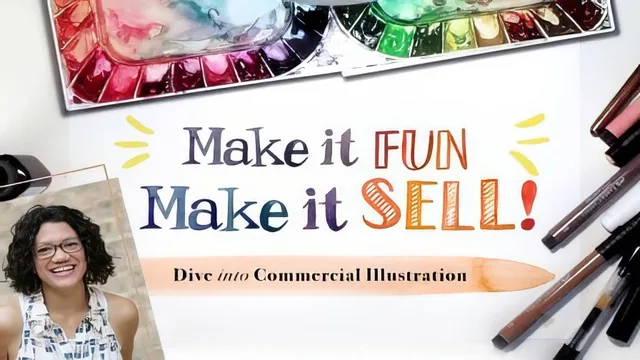
Under an hour, this walks one real client brief from mood board to a finished, sellable watercolor poster.
A brief, not a boot camp
The course frames itself around a single real assignment: a poster brief Amarilys Henderson received from her agency for a set of family-themed prints. Students do not replicate the whole set, just one poster or coaster, built from a food motif repeated across the composition and a hand-lettered quote. That constraint is the course's best structural decision. Instead of an abstract lesson on watercolor technique, everything gets filtered through the question of whether the resulting piece could actually be licensed and sold, which gives the exercises a purpose beyond practice.
The arc moves logically: research and mood boarding, a trend-copying sketch exercise borrowed from an art school assignment, thumbnail layout sketches, painted background, hand-lettered quote, then digital compilation in Photoshop. Three named concepts, trend, marketability, and profitability, get dropped in at intervals to reframe the practical steps as business thinking rather than just painting steps.
What actually gets taught
The painting instruction is real but narrow. The background demonstration covers one subject, a repeated candy corn motif, painted with light-to-dark washes, masking fluid for preserving whites, and colored outline work once the paper dries. It is a legitimate technique walkthrough, but it is shown on one object, so a student choosing a different food motif has to extrapolate rather than follow along directly.
The hand-lettering section is the strongest teaching moment. Wet on wet lettering, where water is laid down first and pigment dropped in and guided while wet, is demonstrated against wet on dry, where a dry brush with more pigment and less water produces thinner, more controlled lines suited to sans-serif or scripty fonts. Naming which technique fits which font style is a genuinely useful, specific piece of guidance that a beginner can apply immediately.
The Photoshop compilation lesson is dense with small moves: separating scanned elements into layers, duplicating and desaturating a color group to compare treatments, using Select Inverse to fill white behind foreground art so it does not muddy against a background layer. It is a fast tour rather than a tutorial, and it leans on a separate scanning class for setup, so students without that prerequisite may find themselves lost on cleanup steps.
Where it falls short
Given its 44-minute runtime, the course cannot go deep anywhere. The trend exercise, copying a well-known design like the "Love" sculpture and adding personal interpretation, is a smart idea for building instinct, but it is given only about ten minutes and no real critique of what makes a good copy versus a derivative one. The profitability lesson on royalties, licensing terms, and lump sums is informative and specific, citing royalty rates as low as two percent, but it is delivered as a monologue with no exercise attached, so it functions more as career context than a skill the student practices.
The class works best as an overview of how a professional illustrator actually operates, moving from inspiration to a licensable product, condensed into a single sitting. It is not a place to learn watercolor technique from scratch or to get thorough Photoshop instruction. Students who already paint and just want to see how a working illustrator thinks about a brief will get the most out of it. Complete beginners to watercolor should expect to supplement with a dedicated painting class.
The standout
The side-by-side wet on wet versus wet on dry hand lettering demo gives a concrete, repeatable choice of technique based on font style.
What you will learn
- How to build a mood board from retail research instead of Google Images
- How to sketch trend-inspired studies before developing original work
- Layering watercolor washes light to dark, including masking fluid for preserved whites
- Wet on wet versus wet on dry watercolor hand lettering techniques
- How to composite scanned painted elements into a layered file in Photoshop
- How licensing terms, royalties versus lump sums, and set-based work affect profitability
Best for: A beginner to intermediate watercolor painter who wants to see how a personal piece becomes a marketable product, start to finish.
Skip it if: Anyone who already knows watercolor fundamentals and wants deep technical painting instruction rather than a business-minded overview.