
Make Creativity Your Career: Six Exercises to Create a Successful Side Project
Andy J. Pizza · Illustrator, Designer & Podcaster
A fast, honest six-step framework for engineering your own creative break, built entirely from one illustrator's own gig-by-gig playbook.
Andy J. Pizza frames this class around a single conceit borrowed from Zelda: your career goal is the castle, and the six steps here are the side quests that arm you for the break-in. It sounds gimmicky in the introduction, but the metaphor holds up because the steps are genuinely sequential and each one produces a concrete artifact rather than a vague pep talk.
The framework itself
The opening move is the "creative identity bullseye," where you sort yourself into industry (the broad field, like illustration), market (the corner you fit, like kids' books), and niche (what makes you specifically you, like weird humor and dream logic in Andy's case). From there you write a goal so short it has to fit on a strip of paper the size of a fortune cookie, the idea being that a vague ambition cannot be reverse-engineered into a plan. The middle steps are where the class earns its keep: you write a creative brief as if a dream client had assigned it to you, then deliberately season it with three specific moves, generosity (giving away the value you'd normally charge for), collaboration (pulling peers into the project instead of working in isolation), and location (finding an underpriced platform before it gets crowded, the way Andy caught the early wave of podcasting).
The most practical single tool in the class is the top-ten outreach list from the promotion lesson. Instead of pitching your dream client first, you list ten names in your market, accepting that visibility drops and credibility rises as you go down the list, then aim disproportionate effort at the bottom few, the ones with an actual email address on their site instead of a wall of gatekeepers. Andy's own example, landing his first two gig-poster jobs with lesser-known bands before eventually working toward Modest Mouse, makes the logic concrete rather than theoretical.
What holds it back
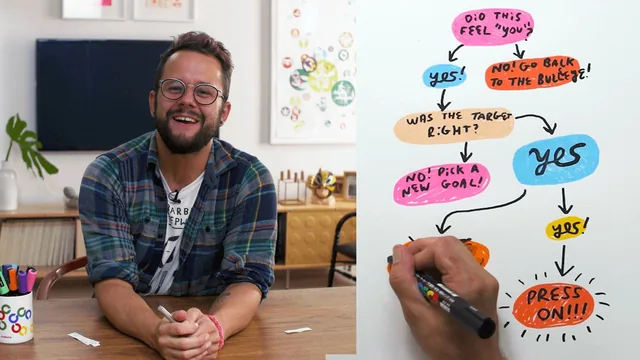
The class runs fifty minutes and covers six steps plus a bonus lesson, which means each idea gets one pass and one anecdote before moving on. There is no worked example that carries all the way through; instead, Andy scatters different case studies (a client's Patagonia pitch, Billy Eichner's talk-show ambitions, his own newspaper-mirroring exercise for the New York Times) across different lessons, so building your own version means stitching the pattern together yourself rather than following one full walkthrough. The closing pivot-or-press-on flowchart is useful as a self-diagnostic but stays abstract, a decision tree without much detail on what to actually do differently on a pivot.
The class also assumes you already have marketable creative skill and just need a strategy for deploying it. Someone without a body of work yet, or someone in a field far from illustration and podcasting, will need to do real translation work to make the exercises land. The bonus lesson on Andy's ADHD and his mother's career struggles is a genuine, well-told piece of context for why he built this system, but it is personal history rather than instruction, so it adds warmth without adding technique.
What the class delivers well is momentum. Each lesson ends with something to actually write down, from the bullseye to the brief to the outreach list, and the workbook mentioned in the course description keeps the exercises from staying theoretical. For someone stuck making work in a vacuum and unsure how to get it in front of the right person, six steps and fifty minutes is a reasonable trade for a repeatable process worth reusing on every project after this one.
The standout
The ranked top-ten outreach list, which trades pure visibility for credibility to find the unguarded back door into a market, illustrated with Andy's own Indie Rock Coloring Book pitch to obscure bands before major ones.
What you will learn
- How to map your creative identity into industry, market, and niche using Andy's bullseye exercise
- How to write a single-sentence goal small enough to fit on a fortune-cookie strip
- How to reverse-engineer a side project brief (problem, scope, deliverables) from a dream client or publisher
- How to bake strategy into a project through generosity, collaboration, and deliberate release location
- How to find a low-competition entry point using the visibility-versus-credibility ranked list
- How to evaluate a finished project with a press-on-or-pivot decision flowchart
Best for: Working illustrators, designers, or writers who already have craft skills but no strategy for turning scattered gigs into a directed career.
Skip it if: Total beginners with no portfolio yet, or anyone wanting hard data on pricing, contracts, or client negotiation rather than a mindset framework.