
Live Encore: Find Your Unique Creative Genius
Andy J. Pizza · Illustrator, Designer & Podcaster
A creativity motivational talk with one solid framework, not a skills tutorial, so judge it by the exercise, not by production polish.
Andy J. Pizza's "Live Encore" is not a technique class. It is a recorded live talk, complete with a Skillshare producer as co-host, live chat call-outs, and a Q&A, built around a single reusable idea: that a distinctive creative voice comes from mapping your influences, not from sharpening your craft.
The Argument Before the Activity
The first half of the 49 minutes is autobiography in service of a thesis. Pizza walks through his own arc: an early viral success with an "Indie Rock Coloring Book," a blown Nickelodeon opportunity right after, a period of quitting illustration altogether, and an eventual return that led to a second, more durable Nickelodeon relationship. The point of the story is to set up his central claim, borrowed and remixed from Ira Glass's well-known "taste gap" idea and a Gordon Ramsay anecdote about scouting young chefs: technical skill is not what separates good creative work from generic creative work. Depth of sensory and cultural receptiveness, what he calls "sensibility," is. It is a compelling reframe, though it leans entirely on borrowed authority (Glass, Ramsay, Joseph Campbell, Jerry Seinfeld) rather than original theory, and a viewer who has already encountered the Ira Glass "Gap" video will recognize most of the intellectual scaffolding.
The Actual Tool: You on a Plate
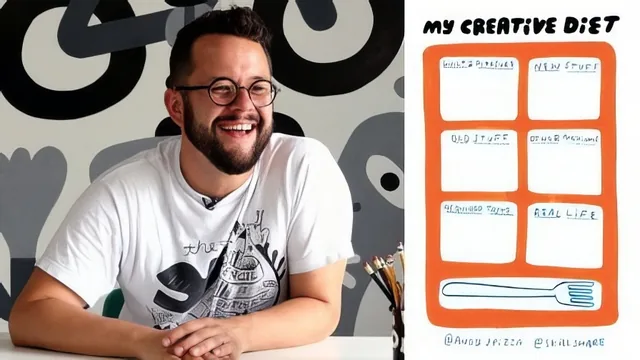
The one concrete deliverable is the "You on a Plate" exercise, introduced about two-thirds through the class. It asks the learner to sort personal influences into six buckets: guilty pleasures, new stuff, old and obscure stuff, other mediums, acquired tastes, and real life. Pizza demonstrates the framework twice before asking anyone to try it themselves: once as a guessing game using Aaron Draplin and Jessica Hische as case studies, then live with the class attempting to fill out the plate for illustrator Lisa Congdon, guessing her influences from erasers to Mary Blair to competitive cycling. This live demonstration is the strongest stretch of the course. It shows the thinking in motion rather than just describing it, and it makes the abstract idea of "sensibility" feel mechanical and repeatable rather than mystical.
What the course does not do is walk the viewer through completing their own plate on camera. The homework is handed off at the end as an Instagram Stories template to fill out independently, so the actual practice happens after the class ends, unsupervised.
Format and Fit
Because this was captured as a live session, it carries the friction of live sessions: tangents about Muppet categories, ADHD, and beer can design, a Q&A that answers only two questions, and pacing that a scripted class would tighten considerably. None of this derails the core message, but it does stretch a fifteen-minute idea across nearly fifty minutes.
There is no drawing instruction, no software, and no portfolio piece produced. The class is a mindset and a worksheet, not a skill-builder, and it says so honestly in its own framing. For someone who has technical ability but whose work feels anonymous or trend-chasing, the six-category framework is worth the time and cheap to try. For someone hoping to build a specific hard skill or see a finished creative process from concept to execution, this will feel thin.
The standout
The 'You on a Plate' six-category influence map is a genuinely reusable, repeatable tool for articulating a personal creative point of view.
What you will learn
- How to distinguish 'creative sensibility' from technical skill using Ira Glass's taste-versus-work gap and Gordon Ramsay's palate analogy
- How to build a 'You on a Plate' influence map across six categories: guilty pleasures, new stuff, old and obscure stuff, other mediums, acquired tastes, and real life
- How to reverse-engineer a well-known creator's influences as practice before mapping your own (demonstrated live with Lisa Congdon)
- How to keep a running influence collection (mood boards, folders, Pinterest) as an ongoing practice rather than a one-time exercise
- Why chasing trends or shortcuts to a portfolio breakthrough backfires, illustrated through the presenter's own Nickelodeon rejection story
Best for: Creatives past the total-beginner stage who feel technically capable but stylistically anonymous and want a structured way to name their influences.
Skip it if: Anyone wanting hands-on technique, software walkthroughs, or a portfolio-ready project should skip this and look for a skills-based class instead.