
Learn to Draw: Daily Practices to Improve Your Drawing Skills
Gabrielle Brickey · Portrait Artist - ArtworkbyGabrielle.com
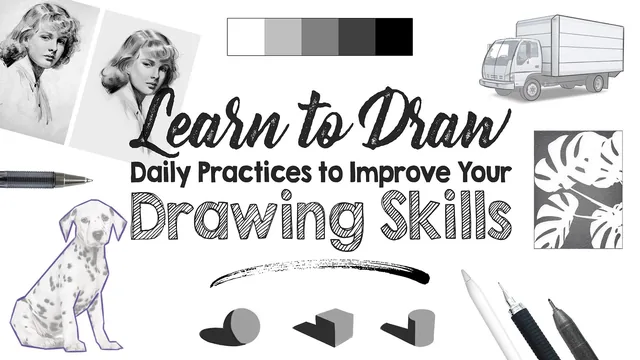
A tight 83-minute fundamentals course that trades hand-holding for a full toolkit of classic seeing-and-measuring drills any beginner can start using today.
A fundamentals course that respects your time
Gabrielle Brickey's "Learn to Draw" packs an unusually complete beginner curriculum into under an hour and a half. Rather than lingering on one technique, it moves briskly through the standard toolkit of observational drawing: shapes, angles, negative space, measuring, form construction, value, and shading. Each lesson runs long enough to demonstrate the idea on a real example and short enough that nothing overstays its welcome. For a beginner who has never had this vocabulary laid out in order, that pacing is the course's biggest asset.
The opening stretch is the strongest. Breaking a subject into flat 2D shapes, then into angled silhouettes, gives a beginner two different ways to get a subject roughly placed on the page before committing to details. The negative-space lesson goes further, explaining why this works: the brain has a pre-built symbol for "dog" or "chair," and drawing that symbol rather than what is actually in front of you is the root of most beginner drawing problems. Working the shapes around the subject instead of the subject itself forces the eye to look freshly. The follow-up exercise, drawing a reference upside down so the subject stops registering as an object at all, reinforces the same idea from another angle and is a genuinely useful habit for anyone stuck symbolizing their subjects.
The measuring section is the most technically dense part of the course, and it earns that density. Dropping horizontal guideline across facial landmarks to check proportion, using one feature as a unit of comparison against others, and overlaying a quadrant grid are all shown twice, once on the iPad in Procreate and once conceptually for traditional media with a straightedge. This dual treatment matters, since the course explicitly serves both a pencil-and-paper audience and a Procreate one, and most technique lessons make the effort to translate between the two.
Where it thins out
The form and value sections cover real ground, constructing cubes and cylinders in perspective, then naming the parts of light and shadow (halftone, form shadow, cast shadow, occlusion shadow, reflected light) on a simply lit sphere, but this is where the course's brevity starts to cost it. Perspective construction in particular is a topic that typically needs far more repetition than a single demonstrated cube and cylinder to become intuitive, and the course itself acknowledges this by pointing viewers elsewhere for a fuller treatment.
The five class projects at the close (drawing from photos, from life, copying a master, quick gesture sketches, drawing from imagination) are less a project brief than a menu of practice categories with commentary on why each matters. That is useful framing for a beginner deciding how to structure ongoing practice, but it stops short of a single worked example carried start to finish, so there is no unified "here is what you'll have made by the end" outcome.
Overall this is a well-sequenced primer rather than a deep skills course, and it is honest about that scope. Anyone who works through the shape, angle, and negative-space exercises on their own paper, rather than just watching them demonstrated, will come away with real, immediately usable habits. Anyone who already has those habits should look elsewhere.
The standout
The negative-space exercise, paired with the upside-down drawing drill, is the single most transferable habit in the course because it directly targets the beginner's core problem of drawing symbols instead of what is actually in front of them.
What you will learn
- Breaking any subject down into basic geometric shapes and angled silhouettes before adding detail
- Using negative space and upside-down drawing to bypass symbolic thinking and copy what is actually there
- Practical measuring techniques (horizontal guideline drops, comparative unit measuring, quadrant grids) both digitally in Procreate and with a straightedge on paper
- Constructing basic 3D forms (cube, cylinder, sphere) with perspective and wrapping lines to show how complex objects turn in space
- Reading a value scale and the five parts of light and shadow (halftone, form shadow, cast shadow, occlusion shadow, reflected light) on direct-lit forms
- Applying all of the above through five concrete practice projects: drawing from photos, from life, copying masters, quick gesture sketches, and drawing from memory
Best for: A true beginner who has never had formal instruction and wants a structured, no-fluff run-through of the classic observational drawing fundamentals in one sitting.
Skip it if: Anyone already past basic shape/proportion/value fundamentals, or anyone hoping for sustained figure, anatomy, or rendering instruction rather than a fundamentals overview.