
Learn to Draw: A Comprehensive Introduction to Drawing Foundations & Style
Mimi Chao · Owner & Illustrator | Mimochai
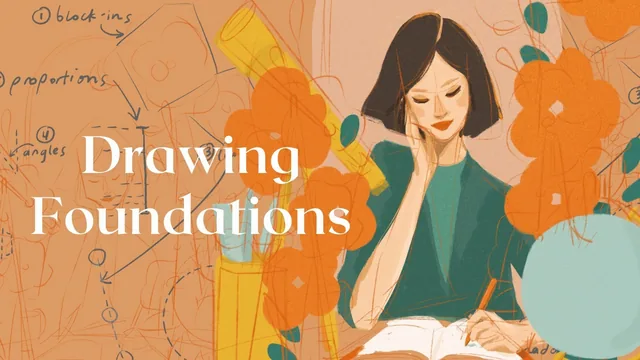
A former-lawyer illustrator distills years of study into one structured foundations course, though its pacing rewards patience over quick wins.
This is a genuine foundations course, not a paint-along. Mimi Chao, an illustrator who has worked with Disney, Adobe and Samsung, structures 262 minutes around five pillars: lines and shapes, value and form, color and light, portraits, and depth and composition. Each section follows the same arc: a short concept lesson, a hands-on exercise, and a return to one running class project (an illustrated "Drawing Explorer" scene) that accumulates every new skill. That single-project spine is the course's smartest structural choice. Instead of scattered one-off exercises, students watch the same drawing gain shading, then color, then a portrait, then perspective, so the payoff for slogging through basics is visible and cumulative.
What actually gets taught
The opening section on lines and shapes teaches observational drawing by decomposition: looking at a reference photo (billy balls in a vase, later a seated figure) and mentally breaking it into circles, cylinders, triangles and trapezoids before a single line is drawn. This shape-first way of seeing is reinforced through basic solid-form drills (turning a circle into a sphere, a square into a cube) that recur constantly in later sections.
Value and form is the course's strongest stretch. Chao introduces grayscale value studies capped at 3 to 5 groupings, the practice of squinting to spot value patterns, and a "major key / minor key" model (borrowed from teacher Bill Perkins) for describing how much of an image is light versus dark, and how much contrast runs between those values. This gives students a vocabulary for mood and composition that most beginner classes skip entirely.
Color and light builds on that foundation rather than replacing it. A full "color garden" painting exercise walks through mixing every hue on the wheel from a base green, observing how white, black, and complements shift a color's temperature and saturation. The portrait section simplifies facial construction into landmark measurements and proportion checks rather than full realism, matching Chao's own flat, graphic illustration style. The final depth and composition section covers planar perspective, foreground-to-background layering, and classic tools like rule of thirds and groupings of three, closing with a full run-through of ideating an original composition from scratch.
Where it succeeds and where it drags
The course delivers exactly what it promises: a map connecting technical fundamentals to a recognizable, stylized illustration practice, rather than training students toward photorealism they may never want. The mindfulness framing around inner criticism and creative fear, woven in early, is a genuinely useful addition for beginners prone to giving up. The workbook (30-plus pages of summaries and exercises) extends the value past the video runtime.
The tradeoff is pacing. At over four hours across 31 lessons, with long unscripted demo segments, this rewards students willing to work through drills that feel repetitive by design (pages of straight lines, ellipses, and basic solids). Anyone hoping for quick, satisfying finished pieces early on will find the early lessons dry, exactly the risk Chao names in her own introduction. It is best suited to someone who already holds a pencil comfortably and wants a genuine structural upgrade, not a first-ever drawing experience.
The standout
The major/minor key framework for planning value (proportion of light-to-dark plus overall contrast) gives students a repeatable way to control mood before a single color is chosen.
What you will learn
- How to break any reference image down into basic shapes (circles, cylinders, triangles) before drawing it
- How to build a grayscale value study using only 3-5 grouped values to read light and form
- How to render 3D form (sphere, cube, cone, cylinder) from flat shapes using shading logic
- How to mix and organize a color palette by hue, then apply it with a value-first structure
- How to construct a simplified portrait using facial landmark measurements and proportion checks
- How to compose a scene using planar perspective, foreground/middle/background depth, and rule-of-thirds groupings
Best for: Beginner to intermediate artists who already sketch a little but want a genuine foundations grounding before developing a personal style.
Skip it if: Absolute beginners wanting fast, satisfying finished drawings in the first sitting, or advanced artists who already have solid observational and value fundamentals.