Learn To Draw: 5 Fun Exercises To Develop Line Drawing Confidence
Mel Rye · ✎ Artist + Educator
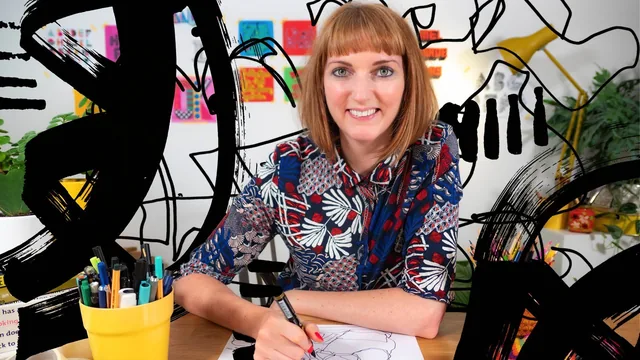
Five gimmick-driven exercises loosen a shaky drawing hand fast, but nobody looking to actually get better technically should expect that here.
A toolkit, not a technique class
Mel Rye is upfront from the first minute about what this class is not: there is no proportion, no perspective, no shading. What it offers instead is a set of constraints designed to interrupt habitual, overly cautious drawing. The course opens with a short diagnostic section on what "unconfident" drawing actually looks like on paper, feathery multiple-pass lines, outlines gone over twice, objects chosen because they seem easy. That diagnostic is more useful than it sounds, because it gives the exercises that follow a clear target: fewer passes, one committed line, media that cannot be erased.
The five exercises themselves are simple by design. Blind drawing has the artist trace an object without looking at the page, using a finger as an anchor point to stay oriented, a trick borrowed from artist Claude Heath's blindfolded work. Non-dominant hand drawing removes fine motor control on purpose. The third exercise experiments with body and pen position: taping a pen to an elbow, drawing on a wall-mounted clipboard, even dancing while drawing. Scale drawing has the student render the same object at roughly 5cm, A4, and A2 sizes to see which scale produces the most natural mark-making. Speed drawing closes the class with 60, 30, and 15 second timed sketches of the same subject.
None of these are novel inventions unique to this course, most art teachers have used some version of blind contour or non-dominant hand drawing before, but the sequencing is what makes the class work. Each exercise strips away a different kind of control, and by the end the cumulative effect of five different constraints in under 90 minutes is a genuinely useful reset for anyone whose lines have gotten tight or overworked.
Where it earns its runtime, and where it doesn't
The subject matter lesson is a small standout on its own. Rather than just assigning an object, the course explains why a moderately complex, recognizable subject, a laced shoe rather than a smooth stone, produces better results across all five exercises, since flat simple shapes give students nothing to hang loose linework on. That's a transferable principle a student can reuse indefinitely, not just a one-off instruction for this specific project.
The mindset section on preparing a distraction-free space, gathering materials in advance, and picking a productive time of day is reasonable but padded. It's advice most people already know, and it doesn't need a full video to convey it. The final "What Next" lesson does useful work in helping students identify which exercise clicked for them and consider how to fold it into future practice, which gives the course an ending point instead of just trailing off.
The materials bar is genuinely low: scrap paper, any pen, tape, a timer. Nothing here requires investment, which fits the course's low-pressure, experimental tone.
The honest limitation is scope. This is confidence calisthenics, not skill-building. A total beginner who wants to learn to draw recognizable things will finish this class no better at rendering a hand or getting perspective right, only looser and more willing to commit to a line. For that narrower goal, though, it does exactly what it promises, and does it efficiently in under 80 minutes.
The standout
The speed-drawing exercise, where drawing the same object at 60, 30, and 15 seconds forces decisive marks and reliably produces looser, more confident lines than any untimed attempt.
What you will learn
- How to identify unconfident line habits like feathery strokes and repeated outlines, and the specific fixes for each
- Blind contour drawing using a finger as an anchor point to track position on the page
- Drawing with the non-dominant hand or an alternate grip to strip away habitual control
- How paper, pen, and body position (standing, taped-on pens, unconventional angles) change line quality
- Drawing the same subject at three scales and under three time limits to see which constraints produce looser lines
- How to pick subject matter, favoring complex, recognizable objects like a shoe over simple ones like a smooth stone
Best for: Anyone with basic drawing ability who feels stiff, overly careful, or stuck in a rut and wants quick, low-stakes exercises to loosen up their line work.
Skip it if: Beginners hoping to learn proportion, perspective, shading, or any structural drawing fundamentals, since the class explicitly sets those aside.