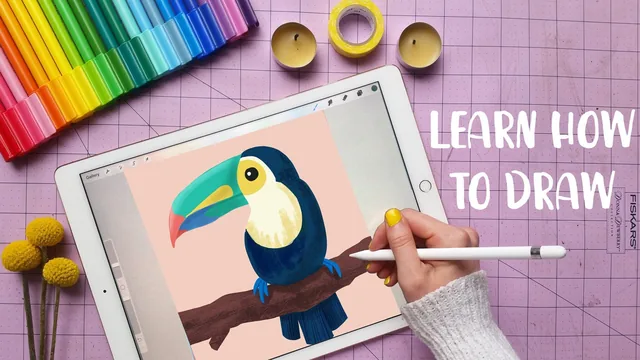
Learn How to Draw! Fun & Easy Exercises for Nailing Proportion, Shading, and More
Brooke Glaser · Illustrator
A genuinely structured beginner drawing course that teaches you to see shapes before it teaches you to shade them, entirely inside Procreate.
This course opens with a claim worth taking seriously: drawing splits into two separate skills, hand-eye coordination and learning to see, and most beginners only ever train the first one. The opening lesson on "Learning To See" lays out why the verbal, naming part of the brain gets in the way of accurate observation, then hands off to three exercises that actually attack that problem instead of just describing it.
The exercises carry the course
The upside-down drawing exercise is the strongest single idea here. Flipping a reference photo so the brain can't label what it's looking at forces a student to copy lines and angles rather than symbols for "eye" or "watch," and the payoff, turning the drawing right-side up at the end, makes the lesson land in a way that pure instruction wouldn't. The shape method that follows is just as useful: reducing a frog or a camel to ovals, triangles, and rough rectangles gives a beginner a concrete starting move for any subject, rather than the vague advice to "just start sketching." The grid and clock method rounds out the trio, and it's the one aimed squarely at accuracy rather than confidence, walking through how to plot a camel's neck, hump, and legs against a numbered grid before refining the sketch.
Where the course shifts, and where it gets a little uneven, is the move into shading. The distinction between cast shadows and form shadows is explained with specific, well-chosen examples, a drop of honey on a teacup, an ice cream cone's gradual color shift versus a woven basket's hard-edged ridges, and that specificity is what makes the shading section worth sitting through. The Procreate-only mechanics that follow, dealing with layer limits, using alpha lock to contain color inside line work, inverting selections to shade under a bird's feet, are genuinely practical if the student works digitally, but they'll be dead weight for anyone drawing with a pencil, since the promise that traditional media can "follow along just fine" thins out considerably once the lessons get this software-specific.
Where it earns its keep, and where it doesn't
The line quality lesson is a smart, under-taught addition: contrasting a smooth door outline against textured leaf lines, or pointing out that varying a slat's thickness keeps a viewer's eye moving, is the kind of finishing detail most beginner courses skip entirely. The two bonus student-feedback lessons, working through real submissions of a toucan, a rabbit, and a barn illustration, add real value too, since watching someone redirect a tilted body or fix a competing focal point does more than another isolated demo would.
The course's honesty about being subjective is a genuine strength: shadows get placed for visual interest rather than strict light-logic, proportions get exaggerated on purpose, and that permission to deviate from the reference photo will free up a stiff beginner. Its weakness is that everything promised about color, the shading types, the tricks, the mood-setting, gets deferred to a separate class rather than delivered here, so a student hoping for a complete drawing-to-color pipeline in one course will come away one step short of that goal.
The standout
The shape-breakdown exercise, where a frog or camel is reduced to circles, triangles, and rectangles before any detail is added, gives beginners a repeatable way to start any drawing without freezing up.
What you will learn
- How to override the brain's naming instinct using an upside-down tracing exercise so hand-eye coordination and observation improve together
- How to break any subject into circles, triangles, and rectangles to sketch quickly without getting stuck on detail
- How to use a grid and clock-position method to plot proportions accurately before committing to line work
- How to distinguish cast shadows from form shadows and place both convincingly on rounded and flat surfaces
- How to manage Procreate-specific workflow issues like layer limits, alpha lock, and selection-based shading
- How to vary line thickness, texture, and confidence to keep a viewer's eye moving through a finished piece
Best for: A true beginner who has never drawn seriously and wants a step-by-step way to build both observational skill and a repeatable sketching process.
Skip it if: Anyone already comfortable with basic proportion and shading who wants advanced anatomy, perspective, or a structured color theory unit, since color is only lightly touched here and pushed to a separate class.