
Learn Guitar: The Complete Beginners Guide
Marc Barnacle · Music Instructor
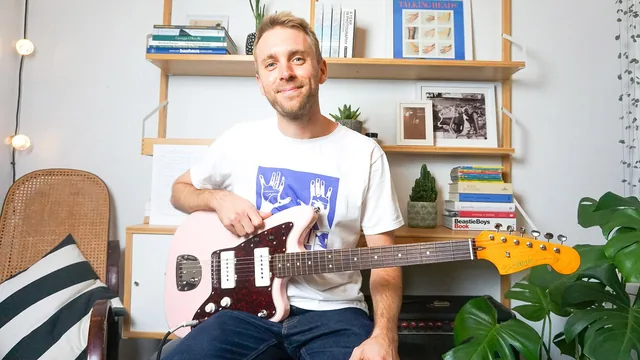
A genuinely thorough 158-minute beginner path that trades polish for real depth, covering everything from tuning tricks to writing your own riff.
A patient, hands-on start
Marc Barnacle's beginner guitar class does not rush toward songs. It opens with anatomy, hand position, and pick grip, spending real time on details many beginner courses skip, like the exact bend needed in a fretting finger to avoid a buzzing string, or how far up the plectrum to hold for control versus flexibility. The tuning lesson pairs a standard headstock-tuner walkthrough with the older fifth-fret relative-tuning method, giving students a fallback when they don't have a clip-on tuner handy. A short lesson on chord boxes and tablature follows, explained clearly enough that a reader with zero music background can start decoding diagrams on sight.
The chord-building sequence is the backbone of the course. Barnacle introduces E minor first, then builds outward to G major, C major, and D major, explicitly choosing four chords that unlock two well-known songs, Stand By Me and Ed Sheeran's Perfect, played back to back to demonstrate how the same four shapes recur across decades of pop music. That's a smart pedagogical choice: rather than drilling chords in isolation, the course proves their payoff immediately. Additional major and minor chords, including E major and A major, are added afterward, with useful notes on sliding between chord shapes without lifting fingers off the fretboard entirely.
Where the depth pays off, and where it drags
The scales section is the most technically rewarding stretch of the course. Barnacle walks through the C major and G major scale as a repeatable finger pattern, then extends it across two full octaves up the neck, explicitly connecting that shape to the composition project that closes the course: writing an original chord progression and improvising a lead part over a backing track. This is a genuinely useful arc, since most beginner courses stop at open chords and never show how scale knowledge turns into creative output.
The pacing is uneven. Some sections, like restringing a guitar, run long relative to their practical value for a first-time player, while the strumming, timing, and rhythm lesson, which covers foundational concepts like beats, bars, and time signatures, moves quickly and could have used more repetition. The instruction style is conversational and occasionally meandering, with Barnacle narrating his own hand movements in detail that works well on video but reads as padding when it repeats across similar chord shapes.
There is no music theory beyond a light touch on how major and minor chords relate by a single note, which is appropriate for a beginner class but means the course stays firmly introductory even at over two and a half hours. The attached PDFs, including full song tabs and extra practice pieces, extend the material well past what's covered on screen, and the final riff and songwriting components giving students an actual creative output rather than passive chord drilling is what sets this apart from courses that stop at technique.
The standout
The two-octave G major scale drilled as a repeatable fretboard shape, then reused directly to improvise lead lines over a backing track the student composes from their own chord progression.
What you will learn
- Guitar anatomy, holding position, and pick technique for both electric and acoustic
- Reading chord boxes and tablature
- Chromatic stretching exercises and a first riff built across the fretboard
- Open-position major and minor chords including E minor, G major, C major, D major, E major, and A major
- Strumming patterns, timing, and rhythm using a metronome, applied to two full songs sharing the same four chords
- The C major and G major scale played across two octaves, used to write an original chord progression and lead part
Best for: A total beginner picking up guitar for the first time who wants a linear, hand-held path from zero to writing a short original piece.
Skip it if: Anyone who already knows open chords and basic strumming, or wants fast results without patient technique-building on tone and hand position.