Learn Adobe Illustrator: Fundamentals for Beginners
Anne Larkina · Graphic Designer, Adobe Max Speaker
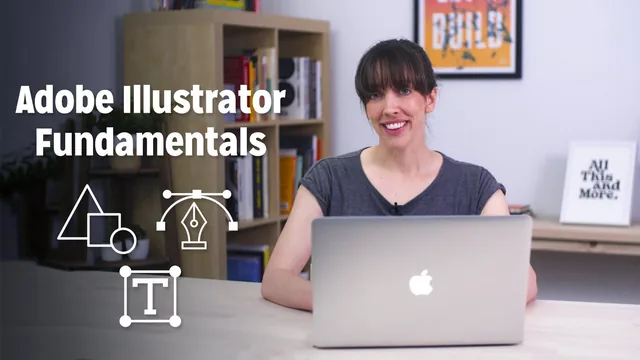
A working graphic designer walks you through shapes, paths and type in 79 tight minutes, building three real graphics along the way.
This is a beginner Illustrator class built around a simple premise: learn three tools (shapes, paths, type) well enough to make anything else follow. Anne Bracker, a working graphic designer, spends the first two lessons on setup rather than diving straight into drawing, walking through document creation, panel arrangement, and keyboard-increment preferences. It is a slower opening than some viewers will want, but it pays off later, since half the speed gains in the rest of the course come from shortcuts established here (space-bar panning, Command-Y for wireframe view, the letter D for a quick fill reset).
The shape section is where the course earns its keep. Rather than treating the Rectangle and Ellipse tools as the whole story, it moves quickly into Pathfinder (Unite, Minus Front, Divide) and the newer Shape Builder tool, showing both side by side so the difference between them is concrete rather than theoretical. A telescope graphic, built entirely from resized and duplicated rectangles with the Rotate tool anchored precisely, demonstrates how far basic shapes can go before the Pen tool is even needed.
The Pen tool section is the heart of the class, and it is taught the right way: not as an abstract curve-drawing lesson, but by tracing a scanned hand drawing of a cartoon alien into finished vector art. The instructor draws half the figure, mirrors it with the Reflect tool anchored at the center point, then uses Option-Command-J to average mismatched points so the two halves meet cleanly. This is a genuinely useful trick that a lot of beginner tutorials skip, and seeing it applied to a messy, asymmetrical hand sketch rather than a tidy sample shape makes it stick. The coloring pass that follows, using the eyedropper with shift-click to target layered fills and manual stacking-order fixes, rounds out a believable end-to-end illustration workflow.
The type section is shorter and covers point versus area type, tracking and leading adjustments, and the Touch Type tool for nudging individual letters. It closes with a small but ambitious exercise: outlining a script font, reshaping the R into a swoosh with the Pen and Width tools, and wrapping secondary text around a circular path. It is a satisfying capstone, though it moves fast and assumes the viewer is comfortable with the Direct Selection tool by this point.
At under an hour and a half, the course cannot go deep on any one area, and it does not try to. There is no coverage of gradients, effects, or print-ready export settings beyond a basic JPEG and PNG save. What it delivers instead is a coherent, project-based path through the tools that matter most on day one, taught by someone who clearly uses these techniques in real client work rather than reciting menu locations. For a total newcomer to Illustrator, it is an efficient way to go from a blank canvas to three finished graphics and a working mental model of how vector shapes, paths, and type actually behave.
The standout
Turning a scanned hand doodle into a clean vector character using the Pen tool plus the reflect-and-average-points technique to force perfect symmetry.
What you will learn
- How to set up and customize the Illustrator workspace, panels, and keyboard shortcuts for a faster workflow
- Building compound shapes with the Shape tool, Pathfinder (Unite, Minus Front, Divide), and the Shape Builder tool
- Drawing and editing paths with the Pen tool, including bezier curve handles and the Direct Selection tool
- Tracing a raster drawing into clean vector paths, then mirroring and averaging points to build a symmetrical character
- Coloring paths with the eyedropper and swatches, and layering stacking order to fix overlaps
- Working with point type versus area type, outlining fonts to reshape letterforms, and setting type on a path
Best for: A complete Illustrator beginner who wants a fast, hands-on orientation before starting their own vector projects.
Skip it if: Anyone who already knows the Pen tool and Pathfinder, or who needs coverage of advanced typography, gradients, or print production.