
Knitting 101: Everything You Need to Knit With Confidence
Vincent Williams · Crochet & Knitwear Designer
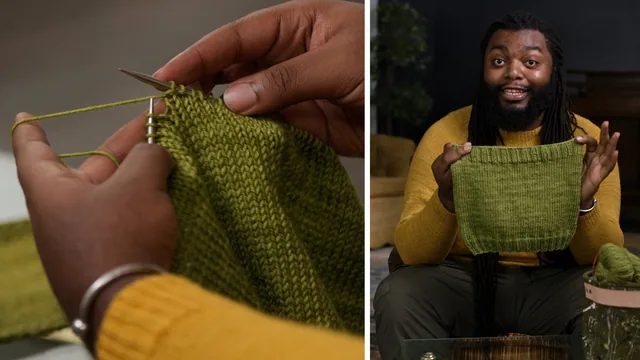
A patient, technique-first cowl class that actually teaches Continental knitting mechanics, not just a pattern to copy.
What it actually covers
Vincent Williams structures this class the way a good in-person lesson would: tools, then materials, then vocabulary, then hands, then project. Before a single stitch is cast on, the course spends real time on needle types (straight versus circular, fixed versus interchangeable tips), the US-versus-millimeter sizing systems, and notions like stitch markers and a crochet hook sized to match the needle for fixing dropped stitches. The yarn lesson goes further than most beginner classes bother to, covering plant, animal, and synthetic fibers, the full weight range from fingering to jumbo, ply count, and the difference between semi-solid, tonal, and speckled colorways. None of this is filler. A beginner who understands why a worsted weight number 4 yarn on a US 8 needle is the standard beginner pairing will make better substitution choices on every future project.
The pattern-reading lesson earns its place too. Williams draws a clear line between "stitch" and "stitch texture," then walks through stockinette, ribbing, and the abbreviations (K, P, STST, CO, BO, STS) that show up in nearly every published pattern. Framing the knit stitch as a lowercase "b" and the purl as a lowercase "d," and showing the same fabric from front and back, is a genuinely effective teaching device for a concept that trips up a lot of new knitters.
The cowl project
The back half of the class is the payoff: casting on 108 stitches, joining in the round without a twist, working two-by-two ribbing, transitioning into a stockinette body to 8.5 inches, then mirroring the ribbing at the top and binding off in pattern. Williams narrates the join-in-the-round technique in detail, including the trick of casting on an extra stitch and binding it off with the first stitch to close the circle cleanly, and he is upfront about the small "jog" that appears where rounds spiral rather than stack evenly. Calling that jog a "design feature" rather than glossing over it is honest and useful, since it is exactly the kind of thing that makes a first-time knitter think they have failed when they have not.
Where it comes up short
The class teaches Continental knitting exclusively, and while Williams' tensioning explanations are clear, a viewer who already knits English style gets no bridge between the two. There is also no troubleshooting lesson: dropped stitches, uneven tension, and reading your own mistakes get one passing mention via the crochet hook, but not a dedicated walkthrough. Because the whole class builds toward one specific cowl at one specific gauge, it does not generalize into shaping, increases, decreases, or garment construction. What it delivers instead is a genuinely solid foundation: by the end, a beginner has cast on, worked both basic stitches in both flat and round formats, and bound off a finished, wearable object, which is exactly what a "101" class should promise.
The standout
The extended breakdown of reading a knit stitch versus a purl stitch as the same loop seen from opposite sides removes the single biggest source of beginner confusion.
What you will learn
- How to choose needle type, size, and material, and read US versus millimeter sizing
- How to identify yarn fiber, weight, ply, and colorway so you can substitute yarn confidently
- How to read written pattern abbreviations like K, P, CO, BO, and stitch counts
- The long-tail cast-on and joining stitches in the round without twisting
- The Continental knit and purl stitch, worked flat and in the round
- How to bind off in pattern and finish a project with a clean, secure edge
Best for: A true beginner who wants one complete, wearable project and a instructor who explains the reasoning behind each motion, not just the motion itself.
Skip it if: Anyone who already knows the knit and purl stitches and wants advanced shaping, colorwork, or garment construction beyond a simple tube.