
Just Start: 5 Exercises That Lead To Big Wins
Rich From TapTapKaboom · Multi-hyphenate Artist
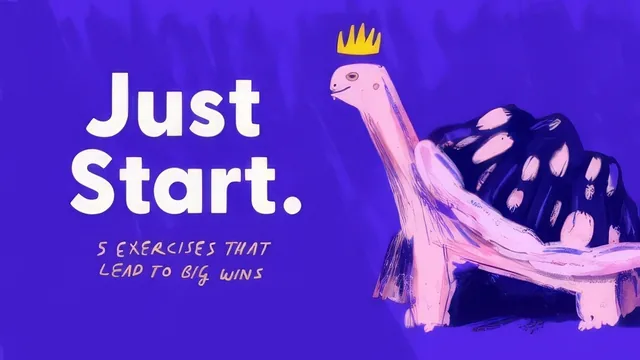
A 22-minute pen-and-paper system for starting stalled projects, built on time-boxed steps rather than willpower or motivation hacks.
Rich Armstrong opens with the tortoise and the hare, and the whole class is built to make you the tortoise. Not the version of the fable where slow-and-steady is a comforting platitude, but a working method for it: five sequential exercises, done with pen and paper, that take a vague ambition and turn it into a scheduled ten-minute block on tomorrow's calendar.
The structure is tight and linear, which suits its 22-minute runtime. Lesson one is scene-setting, lesson two frames expectations, and then four exercises run in strict order: define the goal and its motive, brain dump everything swirling around it, shrink the brain dump down to a next step sized in minutes rather than output, then schedule that step against an existing routine. A closing lesson on removing environmental friction rounds it out. Nothing here requires software or special materials, just paper, a pen, and the printable templates included in the class attachments.
The exercises themselves
The first exercise, the "I really really want to" list, does more than name a goal. It pushes you to ask why three times over, using something like a spider diagram to hunt for the motive that actually grips you emotionally, then discard the ones that ring hollow. Choosing just one goal to carry through the rest of the class is presented as its own small discipline, since spreading effort across everything is treated as functionally the same as committing to nothing.
The brain dump in lesson four is a fairly standard spider-diagram technique, seeded with prompt words like how, why, when, and who, but it earns its place by solving a real problem: getting an overloaded head onto paper so the brain stops using itself as storage.
The most useful idea in the class arrives in "Make It Smaller." Rather than defining a next step as a task ("design the homepage") or a quantity ("write 200 words"), the method sizes it by time: work on chapter one for ten minutes. The reasoning is specific and sound. Time is a hard constraint that's easy to schedule, it decouples your sense of progress from a fickle output, and a small enough number gets a "yes" from a resistant brain instead of a "no." The recommendation to negotiate the number down (30 minutes, then 20, then 10) until it stops triggering resistance is a genuinely practical piece of self-coaching.
The scheduling exercise that follows is where the tortoise metaphor earns its keep a second time, with a direct warning against "binge working," the hare's pattern of racing hard and then collapsing. The suggestion to stop mid-task on a "downward slope," leaving yourself an easy re-entry point rather than a clean finish, is a small but genuinely counterintuitive tip most productivity content skips.
Where it comes up short
The class is honest about its own limits. The final exercise, on removing environmental friction, is the thinnest of the five: it asks you to name three things that might make starting easier, offers a couple of personal examples like removing apps from a phone, and then defers to a worksheet in the class attachments rather than working through the reasoning on screen. Given how load-bearing environment design is for habit formation, this section feels rushed compared to the depth given to motive-finding and step-sizing.
The class also assumes a project that can be broken into short daily sessions worked alone. It has nothing to say about deadlines, collaborators, or work that genuinely can't be chunked into ten-minute units, so it will feel thin to anyone whose stalled project is more logistical than psychological. What it delivers within that scope, though, is a complete and reusable five-step loop that a viewer can rerun from scratch on the next stalled project without needing the class again.
The standout
Sizing the daily unit of work by minutes spent rather than a task or output target, so the brain treats it as achievable and dopamine reinforces the habit.
What you will learn
- How to surface a genuine 'really really want to' goal and dig into the underlying emotional motive behind it
- How to run a spider-diagram brain dump to empty overwhelming project thoughts onto paper
- How to draw a squiggly journey map and isolate only the next visible steps instead of the whole project
- How to size a step by time spent (e.g. 10 minutes) rather than by output or word count
- How to schedule that step into a calendar slot tied to an existing routine
- How to identify and remove the one environmental friction point that stops you from starting
Best for: Creative people with a specific stalled project (a book, an app, a habit) who respond better to a structured pen-and-paper process than to abstract motivation talk.
Skip it if: Anyone wanting a digital tool, project-management software, or techniques for coordinating a team rather than a solo creative practice.