
Just Make Stuff: Getting Creative with Side Projects
Jessica Walsh & Timothy Goodman ♥ · Designers
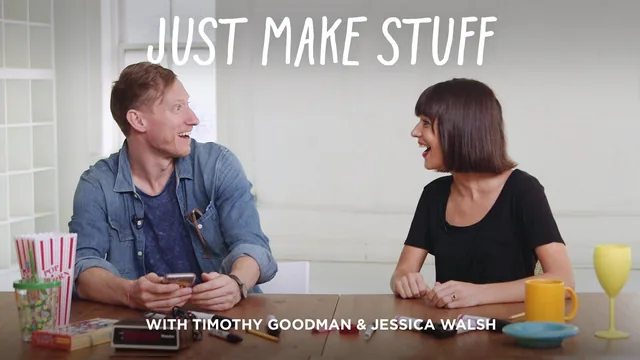
A 46-minute pep talk from two design-world veterans that sells inspiration and confidence more than any teachable craft skill.
Jessica Walsh and Timothy Goodman built their reputations on viral personal projects, and this course is essentially a debrief of how those projects happened, wrapped around a live demo of one of them. The first half is conversational retrospective: the origin stories of 40 Days of Dating and 12 Kinds of Kindness, told as two friends recalling late nights at the bar. The second half turns into a workshop, walking through their lettering project Quotes on Shit from object selection to spray paint to Instagram post.
What it actually teaches
The craft content is concentrated in three lessons: Selecting Your Object, Writing Exercise, and Sketching. Selecting Your Object is the most practical stretch, covering why flat, mid-sized, low-detail surfaces work best for lettering, why matte spray paint (they favor Montana) reads better than gloss, and how close to hold the can to avoid globbing. The Writing Exercise lesson is genuinely a method, not just advice: build a mind-map of words and idioms associated with the object, generate roughly fifteen candidate lines, then filter for phrases that sit between cliche and pure inside joke. Sketching adds one useful habit, tracing the object's outline onto paper first so lettering styles can be tested with a pencil and eraser before anything touches the object in permanent marker.
Lettering itself gets comparatively little instruction. Walsh and Goodman are upfront that neither considers themselves a dedicated letterer, and the lesson leans on intuition and a "just be simple" ethos rather than teaching stroke technique, spacing, or letterform construction. Anyone wanting an actual lettering skill will need to look elsewhere, and the course points this out itself, name-checking other Skillshare instructors like Erik Marinovich and Jessica Hische for that purpose.
Where the value sits
The strongest material is not a technique but a mindset: the repeated idea that constraints (40 days, 12 steps, one object at a time) are what actually get a side project finished. Sharing Your Work follows through on this practically, with specific tactics like emailing design blogs a short pitch with two or three images, releasing pieces on a rolling schedule rather than all at once, and shooting objects against complementary backdrop colors for better contrast in photos.
The weakness is that so much of the runtime is retrospective storytelling rather than instruction. The 40 Days of Dating and 12 Kinds of Kindness lessons are engaging as narrative but teach little that transfers directly to a viewer's own project beyond "have an idea and commit to a format." Someone hoping for a structured framework for generating project ideas will find only loose gestures toward that goal.
As a 46-minute class, it succeeds at what it sets out to do: demystify how two well-known designers turned casual side projects into career-defining work, and hand over a handful of concrete production tips along the way. It does not succeed as a lettering, illustration, or design fundamentals course, and viewers should not expect one. The value is proportional to how much someone already brings to the table. A working creative low on motivation or unsure how to package a personal project will get real, usable ideas. A true beginner looking to build skills from zero will find the class thin, encouraging but not instructive.
The standout
The Selecting Your Object and Sketching lessons, where tracing an object's outline onto paper before lettering it directly is a small, genuinely reusable trick for avoiding irreversible mistakes.
What you will learn
- How to pick a discarded object based on flat surface area, size, and how much text it can hold
- A structured writing exercise using mind-maps and idiom research to land on a short, personal, punchy line
- How to sketch lettering on tracing paper before committing to marker so mistakes stay reversible
- Practical spray-paint technique: matte over gloss finish, holding distance, and two to three coats
- How to pitch finished work concisely to design blogs and use social hashtags to build momentum
- The value of self-imposed constraints (a number of days, a number of steps) to force follow-through on a personal project
Best for: Working designers or illustrators who already have craft skills but want motivation and a real-world case study for launching a personal project.
Skip it if: Absolute beginners hoping to learn lettering, illustration, or design fundamentals from scratch, since none of that is taught here.