
Intuitive Illustration: 4 Quick, Fun Exercises to Unlock Creativity
Amber Vittoria · Artist and Illustrator
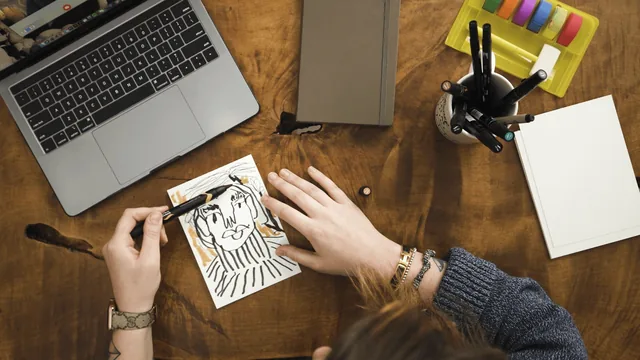
Amber Vittoria's warm-up exercises loosen creative block fast, but 37 minutes of drawing prompts with no skill instruction won't teach you to draw.
Amber Vittoria's class is not a drawing lesson. It is a ritual for getting unstuck, built around four exercises she runs through herself, on camera, in something close to real time. That framing matters going in: anyone expecting to come out with a new technique for rendering faces or shading fabric will be disappointed. Anyone expecting a genuine reset for creative burnout may find exactly what they came for.
The structure is simple and linear. Vittoria opens with a physical loosening-up step, stretching and shaking out tension before ever picking up a pen, then has students draw directly on top of an old piece of work, a magazine page, or even junk mail, specifically so the blank page never becomes the enemy. From there the exercises escalate in discomfort: a self-portrait drawn with the non-dominant hand (her left, since she is right-handed), then a series of quick self-portraits drawn entirely with the eyes closed, and finally a synthesis piece that pulls elements from both into one finished self-portrait made from feeling rather than observation.
What actually works
The eyes-closed exercise is the class's real center of gravity. Vittoria draws two or three portraits in a row with no visual feedback at all, narrating her own surprise at what lands on the page, a plant motif that keeps recurring, a nose sitting higher than the eyes, a portrait that drifts off the edge of the canvas entirely. She treats the accidents as data rather than failure, and that modeling is more useful than any instruction could be. The non-dominant-hand exercise works on the same logic: by making the mechanical act of drawing harder, it makes the psychological act of judging the drawing quieter.
Her delivery carries a lot of the class's value. She is unpolished in a way that reads as genuine rather than performative, mentioning offhand that she nearly knocks her coffee over drawing blind, that she calls her parents when a piece stalls, that her favorite color changes minute to minute. For a class explicitly about giving yourself permission to be bad at something on purpose, that looseness is the pedagogy.
Where it thins out
There is no discussion of materials, no technique walkthrough, and almost no structure beyond "do the thing, notice how it feels." Vittoria works in a sketchbook with brush pens and in Photoshop on a trackpad, and the class gestures at "use whatever you have" without ever addressing how the exercises might play out differently across mediums. Timing guidance is loose to the point of vagueness, a few seconds to an hour for the same step, which suits the no-pressure ethos but leaves total beginners without much of a rail to hold.
At 37 minutes across seven lessons, the class is also thin on repetition. Each exercise gets one pass, demonstrated once, then moved past. That is enough to try the ritual but not enough to internalize it as a habit, which is presumably the actual goal. Anyone who already draws regularly and just needs a nudge out of a rut will get real value here in well under an hour. Anyone hoping to walk away with new drawing ability will not find it, because that was never the assignment.
The standout
Drawing a self-portrait entirely with your eyes closed, repeated two or three times in quick succession, is the exercise most likely to actually shake loose a stuck creative mood.
What you will learn
- A physical loosening-up ritual (stretching, then drawing on top of an existing piece of paper or junk mail) to kill the blank-page fear
- Drawing a self-portrait with your non-dominant hand to bypass overanalysis
- Drawing multiple quick self-portraits with your eyes closed to work from feeling rather than accuracy
- How to combine the previous exercises into one final self-portrait built from instinct, not reference
- A repeatable warm-up sequence to run before any creative session, whatever your medium
Best for: Working illustrators or hobbyist artists who already have basic drawing comfort and want a quick ritual to break through creative block or warm up before a session.
Skip it if: Absolute beginners looking to learn drawing fundamentals, anatomy, or any technical skill, since the class assumes you can already draw and offers no instruction on line, form, or composition.