
Interior Design Basics: Simple Steps to Your Perfect Space
Lauren Cox · Design Program Manager at Havenly
A polished, well-organized primer on the four core principles of interior design that stops short of ever tackling a whole room.
Lauren Cox, a design program manager at the online design service Havenly, structures this course around four principles: color, balance, scale and proportion, and rhythm and repetition. Each gets its own lesson, walked through inside a real Denver home the company designed, before the class moves into personal style and a styling project. It is a tidy, logical arc, and for a true beginner it works as intended: by the end you have names for things you already noticed but could not articulate.
What the principles lessons actually teach
The color lesson is the strongest of the four. It covers warm versus cool palettes, the reliability of complementary pairings on the color wheel, and the idea that a monochromatic scheme is still a color decision, not an absence of one, provided you use at least three shades of it. The balance lesson explains symmetry through architectural anchors like a centered fireplace or bay window, and asymmetry through pairs that share a quality (height, color, material) without being identical, illustrated with a living room where two mismatched ottomans replace a mirrored second sofa. Scale and proportion gets the most concrete rule in the course, that a dining chandelier should be roughly one-third the width of the table beneath it, alongside general advice to measure square footage and wall space before buying furniture. Rhythm and repetition, the least distinct of the four, mostly restates the color and pattern lessons through a different lens: an eye trained to look for a repeated print or material will find that print or material spaced across a room.
Where it thins out
The personal-style section sorts every possible aesthetic into four Havenly-branded buckets: classic, modern, eclectic, and contemporary. It is a workable shorthand but a marketing one, built to match the company's own client-matching quiz rather than any established design taxonomy, and the course never quite hides that it exists to feed people toward a Havenly consultation.
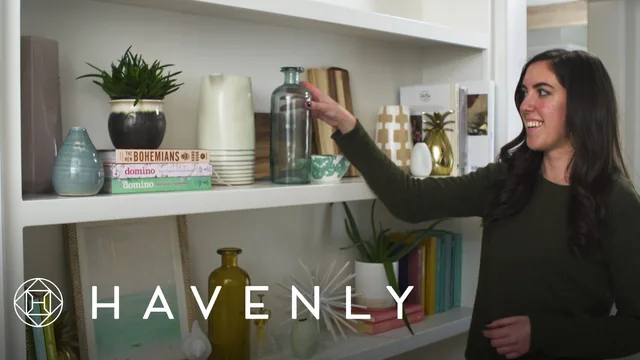
The class's single hands-on project is styling a bookshelf, demonstrated twice in different aesthetics, once refreshing an existing minimalist shelf into a fuller maximalist version, once building a "preppy coastal" look from scratch. The walkthrough is genuinely useful as an exercise in applying the four principles at small scale, layering tall anchor pieces toward the back, grouping books by color, leaving negative space, spacing a repeated accent color across both ends of the shelf. But a bookshelf is a low-stakes, low-cost surface, and the course never scales the same process up to a full room, a piece of furniture shopping decision, or a budget. Anyone hoping to walk away with a plan for their living room will still have that work ahead of them.
At 87 minutes across ten real lessons, the pacing is efficient and Cox is a clear, confident presenter who explains her reasoning as she demonstrates rather than just narrating a finished result. The printable worksheets mentioned throughout add some take-home value beyond the video itself. But this is an orientation course, not a project course: it gives a beginner the words and the eye to recognize good design decisions, without ever asking them to make a difficult one.
The standout
The one-third rule for sizing a chandelier to the width of a dining table is the kind of specific, immediately usable number the rest of the course mostly avoids.
What you will learn
- How to build a color palette using warm/cool theory, complementary pairing, and monochromatic layering with a minimum of three shades
- How to balance a room through symmetry (mirrored architectural anchors) versus asymmetry (similar-but-different pairs)
- How to size furniture and lighting using proportion rules, including the one-third chandelier-to-table-width guideline
- How to create visual rhythm by repeating a color, pattern, or material across a room so the eye keeps moving
- How to identify a personal design style among four families: classic, modern, eclectic, and contemporary
- How to style a bookshelf or shelf vignette step by step, from anchor pieces to books to small finishing objects
Best for: Total beginners who want vocabulary and a mental framework for why a room feels right, before they touch a paintbrush or buy furniture.
Skip it if: Anyone who already knows the basics and wants a walkthrough of a full room renovation, a real budget breakdown, or shopping and sourcing guidance.