
Inspiration To Reality: Make A Vision Board For Your Goals
Jamie Smith · Artist, Teacher & Community Builder
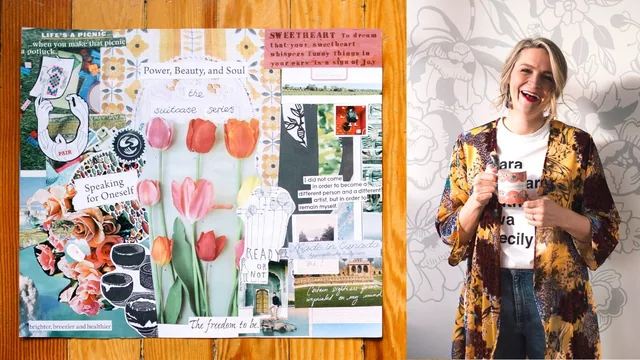
Ten short lessons trade the usual pretty-collage advice for a self-honesty audit, then hand you thirty minutes to cut and paste.
A journaling class wearing a craft class's title
"Inspiration To Reality" bills itself as a vision board class, but the bulk of its thirty minutes is spent on paper before a single magazine gets opened. Of the ten lessons, five are writing exercises: a give-to-get visualization where students write wishes for someone they love and then circle which ones apply to their own life, a Wheel of Life scoring exercise across categories like career, money, and romance, a goal-setting pass that turns low wheel scores into two concrete improvement goals, and a sentence-completion drill ("I am grateful for," "the color of joy is") that builds a personal word bank. Only the final two lessons, Collecting Your Visuals and Cutting, Planning & Pasting, deal with the physical object.
That balance is the class's real thesis: a vision board is only as good as the self-assessment behind it, and skipping straight to cutting magazines produces a board nobody stays connected to. Teacher Jamie Smith frames this through a personal anecdote about an early vision board that read as a "perfect Pinterest board" and ended up making them feel behind rather than motivated. The fix offered is structural, not aesthetic: score your satisfaction honestly, pick two areas to grow and one to maintain, then let those specific goals dictate which images and words get pulled.
What the exercises actually deliver
The Wheel of Life segment is the strongest piece of instruction here, because it gives a concrete method (score each life category one to ten based on satisfaction, not achievement) and a clear worked example, including the point that a person with a million dollars in savings can rate their own money satisfaction lower than someone with a first thousand. That reframing, satisfaction over numbers, is useful outside the context of a vision board entirely.
The give-to-get visualization is a clever workaround for the blank-page problem, using empathy for someone else to surface desires people are reluctant to claim for themselves. It is a genuinely different entry point than most goal-setting classes offer, even if its underlying psychology (that wishing for others is easier than wishing for yourself) is asserted rather than explained.
Where the class falls short is the craft instruction. The composition lesson recommends layering background images first, cutting words cleanly since they go on top, and gluing small pieces onto larger ones for stability, but it never gets into balance, color harmony, or how to avoid a cluttered result. Someone hoping to walk away with real collage or layout skill will find only logistics: buy Bristol board, set a thirty-minute timer, glue last. Anyone who already knows how to build a decent composition will not learn much new about the visual side of this project.
The pacing choices are deliberate and mostly work in the class's favor. Time-boxing both the image collection and the pasting to thirty minutes each is meant to force decisiveness rather than perfectionism, which fits a class more interested in emotional clarity than polish. For a shorter, more reflective take on goal-setting through collage, that tradeoff is reasonable. For anyone expecting a vision board to be primarily a design project, it will feel thin.
The standout
The Wheel of Life exercise, which forces a numeric, category-by-category satisfaction audit before any image gets chosen, so the board reflects real priorities instead of guesswork.
What you will learn
- How to score eight life categories on a Wheel of Life to find where you're actually dissatisfied
- How to run the 'give to get' visualization exercise, writing wishes for a loved one first to unlock wants for yourself
- How to write two improvement goals and one maintenance goal from your lowest wheel scores
- How to fill in sentence-stem prompts to generate a personal word bank for the board
- How to sort collected images into background, symbol, and word categories before composing a layout
- How to plan a composition (photograph it first) and glue it down in one focused sitting
Best for: Anyone who has made a vision board before and ended up with a disconnected 'Pinterest board' look, and wants a structured reflection process instead of just picking pretty images.
Skip it if: Anyone who wants craft or design instruction, since the class gives almost no guidance on visual composition, color, or layout skill beyond basic sorting.