
Illustrate for Merchandise: Transform Your Artwork Into Products
Alicia Souza · Illustrator | Chips connoisseur
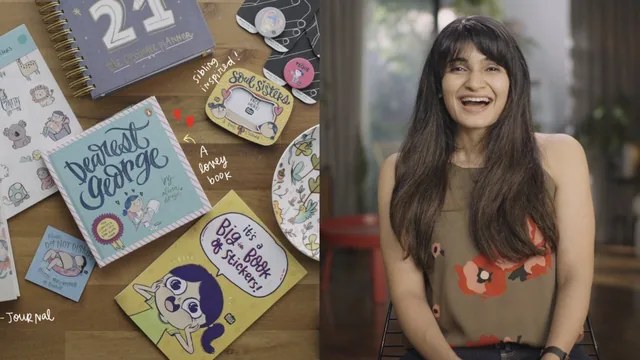
A decade of merchandising instinct compressed into 38 minutes, heavy on mindset and business tips, light on hands-on illustration technique.
Alicia Souza's class moves fast: eight short lessons in 38 minutes cover everything from finding an idea to shipping a finished product. The pace matches its ambition. This is not a deep craft tutorial, it is a condensed walk through one illustrator's decade of trial and error, told mostly through anecdote rather than step-by-step method.
The arc is straightforward. Souza opens with tools and mindset, reassuring beginners that a personal style develops over time and that a pencil and paper are enough to start. She then spends real time on where ideas come from, drawing on stray observations like a stranger's clothing malfunction in South India or a friend's ridiculous old wives' tale, both of which she turned into illustrations that resonated with a wide audience. This section is the class's most useful for anyone stuck on what to draw, since it reframes inspiration as noticing rather than inventing.
The making of the mug
The demonstration project, a set of cartoon bugs printed on a mug, is where the course gets concrete. Souza sketches loose shapes first, then inks over them with a trimmed Pentel brush pen, scans at 400 DPI, and brings the art into Photoshop to clean up, color, and texture. She shows a practical trick of reusing stray pen marks as patterns, turning accidental dots and circles into wings and spots. This segment has real value for a beginner because it demonstrates a repeatable production pipeline, even if the actual Photoshop coloring work is shown in compressed, narrated clips rather than a slow explanation of technique.
The weakness here is depth. Anyone hoping to learn Photoshop coloring, brush selection, or how to build a cohesive color palette will find only surface-level commentary, Souza mentions using Kyle Webster's brushes and picking colors somewhat at random, but does not teach a method for either. The sketching and inking segment is similarly quick, more demonstration than lesson.
Business and manufacturing
The back half shifts to business, and this is where the class earns its "entrepreneur" framing. Souza covers starting with print-on-demand before committing to bulk orders, the tradeoffs of minimum order quantities, retailer cuts on consignment versus outright sales, and hidden costs like storage and shipping fragile items. None of this is presented as a formula, it is closer to hard-won advice delivered in a few sentences per topic. Someone with zero context on selling physical products will come away with a useful checklist of things to consider, but not a plan for executing any of them.
Souza's manner throughout is warm and unpretentious, and the class benefits from her willingness to admit what surprised her, like being unexpectedly won over by t-shirts as a product. That honesty is more valuable than polish. Still, the class functions best as an orientation, not an education. It tells a beginner what the journey from illustration to merchandise looks like without teaching most of the individual skills required to walk it.
The standout
The walkthrough of building a print-ready illustration from loose pencil shapes to inked linework to Photoshop coloring, including scanning at 400 DPI and color mode considerations for CMYK print versus screen printing.
What you will learn
- How to mine everyday life, conversations, and old wives' tales for shareable illustration ideas
- A basic sketch-to-digital workflow: pencil sketch, ink with a brush pen, scan at 400 DPI, clean up and color in Photoshop
- How to build simple filler patterns (dots, lines, concentric circles) from stray pen marks to use as texture
- Practical manufacturing basics: starting with print-on-demand, working with local manufacturers, and understanding MOQ (minimum order quantity)
- How to think through product pricing, including retailer cuts, shipping fragility costs, and not undervaluing your work
- How to use Instagram and Facebook to build anticipation and community around a product launch
Best for: Hobbyist illustrators with some Photoshop familiarity who want a realistic, encouraging overview of turning a single piece of art into their first physical product.
Skip it if: Anyone wanting detailed Photoshop instruction, a repeatable illustration technique, or a rigorous business and manufacturing playbook beyond high-level anecdotes.